Friday, February 13, 2009

The Hope Image, Copyright, L.H.O.O.Q., and the Creation of Value

As many sources recently reported, the Associated Press is going to sue Shepard Fairey for his now-iconic "Hope" poster. The AP claims the poster is a copyright violation since it is derivative of a photograph taken by Manny Garcia and licensed to the AP.

Mr. Fairey admits he used the photograph as a "visual reference". The Hope poster has gone on to sell hundreds of thousands of copies. Mr. Fairey says he put most of the money he made from the posters into making more of the posters.

Whatever you may think, copyright law arguments are supposed to ignore whether the alleged violation "makes money" or not and focus on several other tests. It's not more or less of a violation if you make or don't make money from it.

There are several legal "tests" used to determine whether or not there's a violation:
  • Is the alleged violation "transformative" in nature? This test asks whether or not the new work "transforms" the old work significantly. The new work cannot be a mere replication of the original. It has to "add new meaning". There's a clear, solid argument that it is transformative. This is the essence of what artists like Mr. Fairey do. This is obviously a manipulation of the original image to create a new mood, perspective, and, frankly, image. Mr. Fairey took a portait that I find rather unflattering and was able to recast it as something entirely different. And he did it by changing the original.
  • Is it for the purposes of parody or criticism? I think Mr. Fairey could make some sort of argument here, but if so, it's a rather weak or oblique criticism or parody. This argument will be undermined by the poster's use and endorsement by the Obama campaign.
  • How much of the original is contained in the new work? It would be one thing if Mr. Fairey had literally taken the original photo and slapped "HOPE" across the bottom. That would mean the derivative work contained 100% of the original (and thus the "essence" of the original, which is another goofy test that I don't think remotely applies here). But Fairey's image is several steps removed from the original. It's not clear to me if he scanned, traced, or free-hand drew/painted his version, but the obvious changes (color palette, detail) and subtle changes decrease the amount of the original contained in the new work. If this test passes, it would mean that many others who have taken similar portraits of Obama could also theoretically file claims.
  • What is the financial impact of the new work on the old? This, for me is where it gets interesting.
AP is a company that licenses or buys lots of content from people. They dump the images in a database and don't count on making much from them in the aggregate. Every once in a while they luck into an iconic image and can make a little more.

In this case, AP is arguing something like this:
  • Mr. Fairey's work is a copyright violation
  • Mr. Fairey's work is hurting AP financially
  • AP should be entitled to damages and potentially some or all of the revenue from the violation
But if Mr. Fairey hadn't made the poster, nobody would care about another photo of Barack Obama. Mr. Fairey created new, substantial value for the photo by his creation of the new work and by his promotion and distribution of it.

Unless Mr. Fairey admits otherwise, AP will have a hard time proving that their photo was the only "visual reference" Mr. Fairey used. They may have a hard time proving that he "copied" it by tracing or computer scanning (I don't know how Mr. Fairey works and I haven't seen any overlay comparisons).

Put another way, the poster is, to the average viewer, not a direct re-use of the original AP image. End of story.

AP will also have a hard time proving that he couldn't have created the poster without using their photo. The smart thing for Mr. Fairey to do (and what I suspect his attorneys will ask him to do in the future) would have been to say "I used many different images of Mr. Obama as part of my artistic process, but ultimately the work came from me and my impressions of Mr. Obama."

This article from SFGate notes that some people are saying "well, why didn't he just get a license from AP?" Without knowing the specifics of their licensing process, I'd start by saying "he shouldn't have to, because he's not duplicating or copying their image!"

Imposing a licensing option like this means AP effectively gets control over what Mr. Fairey or you or I or anyone else can do with these images. They can charge too much money. They can require ugly logos pasted everywhere. They can say "no".

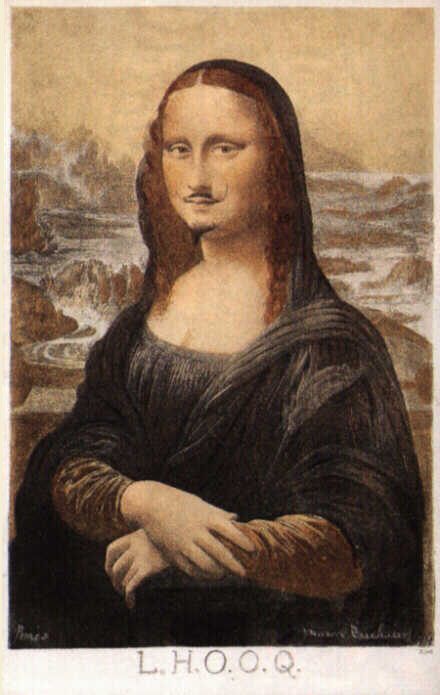
Think about Marcel Duchamp's "L.H.O.O.Q.", one of the best 20th century works. Duchamp created this work by taking a cheap postcard representing the Mona Lisa (so there's already a layer of abstraction) and then adding a moustache , Van Dyke, and the caption "L.H.O.O.Q." (if you say those letters in French, it sounds a lot like French slang for "she has a hot ass").

This piece was scandalous and controversial, as all of Duchamp's best work is. I think it also raises some great questions. Of course, it's knocking the old art world (which venerates the Mona Lisa). Beyond that, it's asking things like "how little does an artist have to do to create something new?"

L.H.O.O.Q. gets much of its effect from the viewer's familiarity with the Mona Lisa image. It's even more powerful if the viewer is someone with a deeper understanding of art history and the art world. But remember, this is built on a cheap postcard knock-off of the Mona Lisa, not the actual painting. Does that make it better or worse?

To me, it makes it even better, because it's starting from a debased and slightly off take on the Mona Lisa. Starting with a postcard also minimizes the "you're just copying" argument, because everybody is copying the Mona Lisa - it's not some lofty thing anymore, it's a poor copy on postcards, coffee mugs, t-shirts and so on.

The graffiti touches are clearly iconoclastic and, to me, hilarious. Much like the Groucho nose-and-glasses, I always find this sort of thing funny. Especially when doodled on Leonardo's masterpiece. Duchamp could have simply added the caption to a straight reproduction of the Mona Lisa. That would have been provocative. But it's the total combination that "works".

I think L.H.O.O.Q. would pass enough of the copyright tests. It's transformative, for sure - it's surprising to me how little he had to do to fundamentally change it (but that's the genius of Duchamp). It also does not hurt sales of Mona Lisa images. If nothing else, Duchamp could hide behind the "criticism/parody" test and get a pass. But today he'd find himself sued by the owners of the rights to the image of the Mona Lisa (yes, there are such fiends) as well as the owners of the rights to the image of the knock-off postcard. And those two groups would likely be facing each other in court as well.

I think AP is going to lose the case, and I think AP should lose the case. Their arguments are weak, their motives disappointing (greed, nothing more, nothing less), and their desire to make culture richer is clearly low.

If, perchance, AP does win, will we ever see another Shepard Fairey or Marcel Duchamp or Andy Warhol or Robert Rauschenberg or Pablo Picasso or any other artists who, forget about collage, just look at pictures before they create? Or even actual things in real life?

Thursday, February 12, 2009

Not Surprised: Sirius XM Financial Orbit Decaying

According to the New York Times, recently merged satellite radio company Sirius XM is nearly bankrupt.

The short term reasons for their financial crisis are simple - they have a ton of debt they need to refinance. For fairly obvious reasons, this isn't a great time to try to refinance millions of dollars of debt. Especially given their past performance.

Another is their primary method of acquiring new subscribers has been through the sales of new cars and trucks. Again, not a great time to be looking for customers there.

But there are deeper, more fundamental reasons why their business is in trouble. Many of their choices have been extremely expensive, which has placed them in a position of needing unrealistic scale for their business.

Sirius XM rely on satellites launched into space to provide service. Launching satellites into space is expensive and risky. As regular readers know, I have a general rule about investing - when someone approaches me with an opportunity that involves launching things into space, I run the other way.

Due to the massive cash outlay to get started with the satellites, the company needed to achieve scale quickly, so they spent something like $500 million (combined) on advertising to drum up business - remember those awesome David Bowie ads?


When that didn't drive traffic fast enough, Sirius resorted to spending lots of money to pull Howard Stern off regular radio and into satellite. It definitely helped their business in the short term but set a bad precedent (excessive valuation of talent) and again drove them to need even more subscribers.

Finally, the fundamental nature of their product is a problem. They require dealing with the music content cartel, which charged them an arm and a leg for permission to broadcast music. Satellite radio isn't actual "terrestrial radio" and thus requires its own set of negotiated deals. This put huge limits on the amount that Sirius XM could expect to make. If the deals they got are anything like the Internet music business, Sirius XM was never going to make significant cash.

Sirius XM requires the listener to purchase a special receiver to get the transmissions. Initially, these receivers were around $200, which isn't cheap. Especially compared to an iPod or FM radio. iPods provide more control and FM radio is free (if annoying as hell). On top of buying a receiver, listeners had to pay a $10-ish monthly fee (like cable TV or Rhapsody).

All to get about 100 channels, most of which you're not interested in.

Their service is fine - the sound quality is adequate (but not more than adequate) and if you like the radio model of "we'll play a bunch of music at you", they do a pretty good job, with a larger pool of songs than regular radio (but not as large as Internet radio) picked by "radio experts".

And then there's the Internet. Sirius XM operates on an old-school broadcast model. The youth of today aren't into tuning into the same stuff everyone else is. They want a custom feed they control and the ability to check out what their friends are listening to. Music lovers today are used to iPods and control, cover art, ratings, and of course, the ability to listen anywhere they can get WiFi.

Sirius XM is a poor fit in that world, and that, combined with their inherent and short term prices, probably means they'll file for bankruptcy and disappear. Like Iridium, the "world phone" provider (another satellite investment company) their satellites will end up silent, used for other purposes, or smash into other satellites.

Wednesday, February 11, 2009

Day 10-11: I Remember L.A. (updated again with MP3 links)

Unlike past years, I decided to send some rough mixes around to friends to get their thoughts on how things are sounding and whether or not the songs work for them. The good news is the response has been very positive and the feedback has been very helpful. The bad news is now the pressure is on...and all that great feedback translates into more work on the tracks.

I felt that I needed to get something else done, so last night I started working on "I Remember L.A.", sketching it out pretty quickly. I was going for a David Sylvian/Christian Fennesz type of thing.
I came up with a nice melody, somewhere between a lullabye and a children's song. Reminds me a little of "On Top of Old Smoky". I also created a very simple set of chords to accompany it and mapped out some appropriate bass notes.

After creating a minimal, nearly inaudible beat, I recorded the bass.
I recorded 4 individual guitar notes and broke them out to individual tracks, looping them and letting them drift out of sync.

Next I processed each note individually - one getting distortion, one getting a granular delay, and so on. I also recorded a few tracks of noise and hum and processed that as well.

I sung a decent vocal take and started "painting" the guitar parts around the melody, dropping them in and taking them out as I saw fit. I wasn't sure if it would work, but it ended up sounding very good.
I did a quick mix and called it a night. Getting up today was tough. I did my morning exercises and brought the mix up. Vocal was nice, but a touch too simple. It needed some harmony to give it some motion and interest, and to keep it from being too monotonous.

I raced through the vocal a line at a time dropping in harmonies I thought were good and ran a mix off.

While the mic was up I re-ran some of the vocals for "The Signal" and for "Resigned".

A bit late for work, and the bass was way too loud, but man, "L.A." sounds good. More or less what I wanted.

Tonight I ran through my mix notes - fixed the bass, tweaked some processing, danced some levels around. I think it's done, or very close. I then turned my attention to working on "The Signal" to integrate the vocal work I had done today.

Some of the takes aren't usable - I was too congested or something, and the original takes sound better. But it's good enough now that I think I can move on.

It's 11:58 pm and I'm tired but satisfied. 3 songs all but done. 13 minutes down, 22 to go.

Update: These are final mixes, uploaded now that the album is done.
I Remember L.A.
The Signal
Resigned

Monday, February 09, 2009

Thoughts on the Amazon Kindle (Updated)

Stretta, the musician who makes great piano music, recently wrote a post about the new Amazon Kindle (2). He makes a few good observations, but I think misses a few more.

There have been a number of serious attempts over the last 10 years to make electronic books - Rocketbook, Sony's eBook...the Kindle is just the most recent.

I don't think electronic books are going to change the world. Let's set aside the technology improvements required, chief among them being affordable, high resolution color screens. Let's think about the total experience of a regular, old fashion, analog book.

Books are one of the most refined and mature technologies humans have. Books are easy to duplicate, either at the time of printing or after the fact. In quantity, they're dirt cheap.

They are a very robust technology. Books can be readable for hundreds, if not thousands of years, can survive immersion in water, burial, and extremes of cold and heat. They don't require a power source. They have no boot-up time. They are useful and readable even with some data loss or physical damage.

Some have primitive search technologies built in (tables of contents, indices). They can support text and high resolution graphics. They're portable.

Books can come in a variety of sizes. Different paper stocks allow conveyance of different meanings and experiences. Books serve as visual indications of status, intellect, and tastes.

At the gym a few months back I saw one of the freak parade talk show hosts giving their guests some great American cargo cult advice - "Rich people have a lot of books in their house, so go buy some books" (because presumably then you'll be rich).

A stack, pile, or wall of books at someone's home or office tells you about that person. If you walk into the same situation and only see a Kindle or a laptop, it tells you something else. These cultural elements are strong and slow to change, especially given books' longevity as a technology.

Even though the above things have nothing to do with "reading" (as in "getting the information from the text") I believe in the case of books they are as important, and in some cases more important, than getting the information from the text.

The creators of electronic books are either unaware of these elements of books (unlikely) or they're choosing to ignore or minimize them, believing them irrelevant to the greater feature set offered. Despite the fact that I arguably work on the same thing, but for music, I think they've misjudged things, and that's one reason electronic books will not be a mass market technology.

I believe these devices do have potential markets once they're a little more refined. Yes, there's the "road warrior". I know one of these guys, and he loves his Kindle. He's also on a long plane flight at least every other week. Are you? Small market.

One obvious market is replacement of college textbooks. The hard-nosed businessfolk who are "forced" to charge outrageous prices for college texts will gladly stop trying to guess how many heavy, boring, and soon out-of-date books they have to manufacture. They will dance in the streets out of fiscal joy when they realize they can DRM or license the books to individual readers and kill off the used book market. They may even choose to lower prices.

Students will benefit from being able to carry all their texts with them anywhere, write in the margins, search, and do all the other wonderful ebook things they've been promised.

The other area that makes sense for me is replacement of periodicals. The manufacturing and distribution of this ephemeral content will make less environmental and financial sense as time goes by.

Electronic versions of magazines could be "printed" without the multi-month lead time required by today's magazines, updated frequently, and would provide an instant, easy way for subscribers to store every issue they ever receive. Your neighbors can't steal electronic newspapers and magazines, and the post office (assuming they're still around) can't shred the crap out of them either.

But I'd also note that any of the improvements required for electronic books to succeed will almost certainly be ported to other technologies - the laptops and handhelds and monitors we all use. The high resolution color screens will appear in all of these areas. They'll also end up as your desk surface, your wrist watch, and billboards.

The fact that a laptop will be "good enough" for most users (and thus represent a huge market) will continue to undermine the electronic book market. A likely outcome is that dedicated electronic book readers may have marginally "better" qualitative experiences, and potentially get some content in advance of the PC world. Ultimately, though, I think they'll remain a niche product.

I use "electronic book" to refer interchangeably to both the content and the device, because they're largely the same. Vendors won't create content with color imagery and covers if the devices won't support it. The devices won't add the cost to support it unless the vendors are going to invest in it. (Hint to both parties: Comic book geeks will love you if you get this right!)

I won't go into the problems and absurdities of the current closed and DRM-protected formats - it's like the record business. All you need to know is "these formats don't matter", and I would advise only making purchases you don't care that much about. You'll get a better lifetime out of a used paperback than a DRM-protected electronic book.

Update:
Another reason electronic books won't catch on is the idiocy of the content industry, as evidenced here. Much like the music business, or perhaps the government, they're so busy trying to "protect" their business they're actually destroying its future.

Sunday, February 08, 2009

RPM Challenge: Day 7 - Breakthroughs

This year's record has felt more difficult than the previous years. Perhaps I have excessively high expectations, given how well the other records turned out. Maybe I've just made things very difficult for myself. Likely I have forgotten exactly how hard the last 2 years were. Whatever the reasons, I've had a tough time getting into a working groove.

Today I managed to get one of the new songs to "kick over" - to get to a point where it actually sounds like it will work and is tolerable. Even my lovely wife said it sounded good, and she's a tough critic, especially of my computer-involved music.

The track is tentatively called "The Signal". I took it from being a 1:30 sketch to a reasonably interesting 5:00 track. It still needs some drum touches and final vocals, but I think it's otherwise nearly done.

Yesterday and today I also moved the lyrics along quite a bit. I've got some momentum going now. It always gets easier after the first couple of tracks.

On a more technical note, I'm recording at 24 bit, 88.2 kHz, which is "better" than my previous 24 bit 44.1 kHz settings. I initially tried 24 bit 96 kHz, but it was just too unstable and not as suited for CD conversion. I have to be a bit more careful about plug-in usage with these new settings - it definitely is harder on the CPU.

I think I'll have to go back to using the Pod a bit more for amp emulation. Reaktor does a fine, or at least interesting job, but it's too much CPU for not enough difference. I think I'm better off treating the sounds afterwards. I don't need the extra flexibility. Either that or I need to print the effects sooner.

Tomorrow I will make some efforts at a David Sylvian/Fennesz-influenced track.

Friday, February 06, 2009

RPM 2009 - Days 3-5

I'm in a familiar state - I am saying "Wow, this is all awful. Maybe I won't finish. Maybe I won't release it."

I've been unusually tired. Getting up at 6 every day isn't helping, and it's made the idea of staying up late to finish anything a non-starter.

I'm still going over the chorus for "Resigned" - Not sure if the melody is good, not sure if the lyrics are good. I'm going to commit this weekend, no matter what. Or at least get it to a point where I can stop thinking about it. I just want to stop looping it in my head and trying new things. I sort of felt this way about "Daemons" last year and that ended up being one of my favorite tracks.

I've also been doing a little work on the second track, which is tentatively called "The Signal". I wrote some lyrics - enough to sketch out the idea and point in a direction to finish the track.

I've got a bit of guitar down and a beat. I've started experimenting with what David Torn calls "cell guitar", where I'm chopping up bits of parts and/or repeating sections. It's started to sound a little more interesting and I think is a good direction to explore for a few tracks.

That experiment has helped me sketch out a kind of spectrum for the record, where at one end is semi-straight-ahead stuff like The Church and the other end is Fennesz and David Sylvian. If I can have songs all across this spectrum, I think I'll have something interesting.

If nothing else, Air King Sound likes the beats I'm making, which is good news. The Konkrete drums are very different from what I've used in the past. Of course, my initial reaction is to be concerned that it doesn't sound "right", but then I tell myself my objective is to do something different anyhow.

Day 5 brought some much-needed rain to the Bay Area. Work and appointments kept me busy enough that I couldn't go to the gym. By the time I got home I was extremely tired and just listened to the tracks a few times before leaving for a friend's send-off party (6 months in China).

On the way home I started getting a new song idea. Wrote down some words and sang a melody.

My objective for the coming weekend is to finish these first 2 tracks and at least start on a third. Failing that, I'll start a bunch of new ideas (3 at least) and finish them up over the next few weeks.

I forget how hard this can be.

Monday, February 02, 2009

RPM 2009 - Day 1 - "Resigned"

It's February. That means it's time for the RPM Challenge. I'm participating again this year. You'll find many of these entries at the bottom of this page, along with the occasional audio draft.
--
This year I plan to try to record something every day, even if it's just a doodle or an overdub. So before I did anything else, I recorded a little idea - just something simple on guitar with a little bass underneath it.

Then I spent a few hours finishing some basic studio preparations - sorting drum kits, creating file templates, changing strings, tuning.

But I could hear the clock ticking and felt the day slipping away, so I pulled out my lyrics book and started working on the first song idea that felt strong to me.

I wrestled with it for a while - as I suspected, I'm not comfortable writing on guitar or bass these days. So of course, that's what I did. I'm making it even harder by not allowing myself to use the chords and ideas I would normally fall into.

I plan to try to get more unusual timbres from the guitar and bass, but for now I just wanted to get something down. I sketched out a basic idea with a nice drum kit. Not happy with the guitars at all, but at least I could hear it. Then off to the gym.

I hadn't gotten more than a few blocks from the house when I got a new idea for the verse melody. I could tell I'd have to re-track the bass and throw away the guitars. Still no melody for the chorus yet.

Post-gym, I tweaked the drums a bit. Put down the modified bass and whispered a quick guide vocal to check the melody idea. Put down a few ideas for some backing vocals on the chorus.

And then started endless lyric revisions. Not happy with it yet, but it's coming along. Funny how these ideas start to come poking out as I scrape away at the words.

So far, this song is about a former spy (McGoohan/6? Westen? Dad?) and it owes a debt to The Church. Working title is "Resigned".

Friday, January 30, 2009

Internet Famous (and real world infamous)

A story about Internet streaming royalties ran today in BetaNews.
...citing passages from over two years of testimony from members of the recording industry as well as representatives of Internet radio, CRB Judge James Scott Sledge went out of his way to shame apparently everyone for not being much of a help. For example, representatives of the Digital Music Association (DiMA) were chided for, at one point, not being able to provide a clear definition of "streaming."
Last February, the judges had already concluded that the definition of "streaming" was a matter of fact, not law. So when asked to provide facts in testimony the following May, Rhapsody America general manager Alexander Kirk stated it could really mean lots of things: "I mean, one of the wonderful things about computers on the internet is they offer you a number of different ways to do things," reads the CRB's citation of Kirk's testimony. "And streaming can encompass a whole range of behaviors."
This is only a tiny piece of my testimony, and it is presented here out of context (my written statement is here, all related documents here). The reason I was asked to talk about streaming has to do with the calculation of royalties and negotiations around same. So details are very important.

I said "streaming can encompass a whole range of behaviors". I'll expand here. "Streaming" can mean a bunch of different underlying technologies, but generally only one type of "experience". Most people think of "streaming" as an experience differentiated from "downloading".

When downloading, you're acquiring a local copy of the file, which you may then play, copy, store, delete, etc. But your primary goal is to get that local copy of the file. What you do with it after that is secondary.

When streaming, you're interested in experiencing the file (watching, listening, etc.) and you are not particularly interested in keeping a local copy. As far as you are concerned, there is no local copy made. Most streaming experiences are designed to provide this impression.

But in point of fact, very few modern streaming technologies open up a direct connection between you and a single central server and pass bits directly to your machine. There are various caching stages in between. Your OS may cache some or all of the file in RAM or on the hard drive. Your player or browser may cache some or all of the file in RAM or on the hard drive. There are many technologies that look and feel like streaming to the user, but are actually downloading. There are other technologies that sit somewhere in the middle.

The example I kept coming back to was YouTube. Nominally, it's a streaming service. You play it, it's gone when you're done. But if you pause a video, it will download (or buffer) the entire video in your local machine's memory. Guess what? Now it's a download (under some definitions). So what type of service is YouTube?

That's why I refer to "streaming experiences".

The danger with defining streaming as a technology rather than an experience is the technology to enable the experience is continually changing. Especially given the glacial pace of lawmaking, you end up with a bunch of laws that don't end up being relevant to the issues at hand. You also run the risk of legally boxing in "streaming" so tightly that nobody uses it, and thus all the discussion is for naught.

Also, I'm not the "Rhapsody America General Manager" - I'm the "General Manager of Product Management for Rhapsody America". The RA GM is a big deal. I'm just a guy who works there.

Soon I will post about my experience testifying for the Copyright Review Board. It was fantastic.

Friday, January 23, 2009

Escape Philosophy is Piano Music

One of my big discoveries of 2008 was Escape Philosophy, also known as Matthew Davidson. He creates beautiful piano music and has two albums available on Jamendo (a free/paid download service):

I really love it. These two records are on par with both Harold Budd and what Roast Beef describes thusly:

Highly recommended.

Special thanks to Chris Randall of Audio Damage for the tip.

Wednesday, January 14, 2009

Number 6 Has Finally Escaped The Village

Patrick McGoohan is dead.

Few things have affected me as profoundly as "The Prisoner", his visionary, bizarre television series. WIRED has a good article, and this interview is also worth a read whether you're familiar or not.

I remember seeing the Prisoner on public television before I was a teenager. I don't remember much about those viewings beyond vague impressions - I asked my parents many questions (I did that a lot). I remember the ending of every show - his face silently flying up on the screen as bars slam shut with a giant, echoing noise.

But like many things from childhood, those vague impressions left a mark, and by the time VCRs and cable TV (late to Northern Virginia) were commonplace, I spent every weekend scanning the TV listings to see if it was airing again. Eventually in the summer of 1990, PBS ran some of them and when I could remember to set the VCR and it cooperated, I got a few grainy episodes.

College is probably the best time to see The Prisoner, as its references and ambiguity resonate more. Plus you can walk around the campus (its own little village) saluting people and grimly saying "be seeing you". Which I did. If I had found a dark blue jacket with piping, I would have worn it with white Keds. I even joined "Six of One" for a while.

The more I learned about the show, the more impressed I was. He came up with the idea, pitched it, wrote episodes, directed. There were even meta-layers of story - McGoohan had broken big playing a secret agent (John Drake, in "Danger Man", a.k.a. "Secret Agent" - the show with the famous "Secret Agent Man" theme song). After more than 50 shows he wanted to stop - to resign - and they didn't want him to. He started wondering about what happens to secret agents when they resign...

Finally all the episodes were released on DVD, and I bought the set. Not every episode is perfect (McGoohan wanted to do 10, they made him do 17 to get a deal), but even the lamer ones feature his steely determination and undermining of the genre while simultaneously hewing to its conventions.

He never uses a gun. There's always a stagey-looking fistfight. But often as not, he gets the crap beat out of him by the goons in the stripey new wave/French t-shirts. He's smarter than everyone else. They can't break him. But he never escapes. Even when he escapes, he can't escape. The fix is in, and everyone in the world seems to be in on it.

The show makes me laugh and makes me very sad and cynical. What more can you ask for of art? It also serves as an interesting period piece. I can't imagine anything this creative and subversive ever getting on television again.

The "election" episode alone is worth the price of admission. Its title, "Free For All", is the type of dual meaning McGoohan (who wrote it and several other episodes) laced throughout the series.

McGoohan saw the world as it was and as it could be in positive and negative futures. A cranky guy, cranky for the right reasons. Also did fantastic acting in "Hell Drivers" and "Ice Station Zebra".

In 1977, McGoohan said:
"We're run by the Pentagon, we're run by Madison Avenue, we're run by television, and as long as we accept those things and don't revolt we'll have to go along with the stream to the eventual avalanche...As long as we go out and buy stuff, we're at their mercy.
...
"We all live in a little Village...your Village may be different from other people's Villages, but we are all prisoners."
Be seeing you.

Wednesday, January 07, 2009

The Music Business: The Future is Bright, The End Is Nigh

The following essay was the basis for a talk I gave at a recent Dartmouth Digital Musics Symposium

1. A Brief History of The Music Business

Technology and technological friction created the music business. New tools took what had been ephemeral and transient – music – and captured, tamed, and sold it, caged in a perforated paper roll or pressed into a platter. Those tools were exotic, expensive and rare. Thus, access to the ability to record and duplicate music was controlled.

Even as technology enabled the music business, technology began to shape and change music in ways great and small. Most of the 20th Century’s points of musical interest come from this shaping and changing, ranging from Thaddeus Cahill’s Telharmonium to musique concréte to synthesizers and the computerization of music.

The technology also disrupted the existing music business. In 1906 John Phillip Sousa wrote a magazine article called “The Menace of Mechanical Music.” The piece was written for two reasons (one of which I’ll address later). The first was a public plea for composer’s copyrights – piano rolls weren’t considered music and thus ineligible for royalties.

Piano roll manufacturers were creating scores of piano rolls and selling them, and composers got nothing! “Piracy” of music like this was impossible to stop – a talented musician can hear a composition once, play it from memory and transcribe it – that’s how Mozart famously “stole” a mass from a church. There was no way to stop it.

The piano roll situation was especially bad for composers since people who had “reproducing pianos” and bought piano rolls would likely not buy the piano sheet music – why did they need a score for a human when a machine would be doing the playing?

Partially due to Sousa’s public and political lobbying, copyright law was changed. A significant result was creation of the mechanical royalty. Mechanical royalties in the USA have two very interesting qualities: they are compulsory licenses and they are offered at statutory rates.

A compulsory license means the copyright holder cannot refuse to grant someone a license. Surprisingly, this was something requested by the composers, who were concerned that one monopoly company (Aeolian, the Apple of their day) would buy up all the rights and control the market. As a result, the laws were written such that once a composition has been publicly released, anyone can get a license to make a mechanical copy of the composition – the copyright owner is compelled by law to grant the license.

“Statutory rate” means the cost of that license is set by Federal law. The rate is currently about 9 cents per copy. It’s a per-copy created rate, which means even if you make 1,000,000 piano rolls and then burn them all, you still owe royalties. This prevents the rights-holder from creating a monopoly and has the side effect of treating all compositions equally.

The compulsory licensing of compositions at statutory rates is how many composers make money – those royalties are an essential component of the music business.

All of that was required because people realized it was impossible to stop people from creating copies of compositions – if I sing a melody to you, you could sing it right back to me. Or to your friends later. Or in a concert hall.

From an economic perspective, these radical changes in law had the effect of changing the incentive structure – if you were required to allow people to copy your work, and they had to pay you a fixed amount of money if they did so, the winning strategy is to actively work to get people to copy your work! The music publishing industry started to dramatically expand in terms of size, revenue, and reach.

Sound recordings complicated things. Of course, sound recordings were much more difficult to duplicate, and nearly impossible to duplicate well without access to the original master and/or lots of exotic, expensive, and rare equipment.

Sound recordings are different from compositions, and so is the copyright law that refers to them. Composing had been around for hundreds of years, and people had ample time to consider the business thoroughly. Sound recordings were new, and the record companies (then and now, typically the owners of sound recording rights) had no desire for government regulation of the fruits of their investment in the nascent business and expensive equipment. So no compulsory licenses at statutory rates. The record companies effectively controlled the reproduction of sound recordings.

Or at least, they did until the digital era.

Digital recording brought tremendous benefits to the music business. Better sound quality and the ability to re-issue and re-sell almost every record they had previously sold. The CD helped lift the music business out of its early-80s doldrums and into a prosperous period. The CD was the ultimate reproduction format.

The CD was also the beginning of the digital revolution. A few short years after the commercial launch of the compact disc, recordable CDs hit the market, alongside consumer CD burners.

Personal computer technology started its rapid evolution. Processors got faster. Storage grew bigger. Connections between computers grew and began to accelerate. The Fraunhofer Institute created a perceptual data compression scheme known as MP3.

And then in 1999, a college student created Napster, which wrapped an easy interface and massive connectivity around what was previously a complex affair – swapping digital files of music on the Internet.

Suddenly, almost literally overnight, copying music had become effortless. A click, and a copy was made – of both the sound recording and the underlying composition. And there was no way to stop it.

2. Rhapsody and Today’s Music Business
In 2001 the first version Rhapsody launched. A week later, Apple introduced the first iPod.

These two products embody the digital music business. My colleague Tim Quirk says “iTunes is yesterday disguised as tomorrow.” iTunes sells digital singles and albums, in a no-frills, no-excitement vending machine available online. The iTunes Music Store was started primarily to combat accusations that iPods and iMacs encouraged music piracy. Today, iPods hold thousands of songs, but the number of purchased songs per iPod continues to remain around 20.

iTunes is not fundamentally different from buying CDs in a record store. The pricing is about the same. It is certainly convenient, and the selection is immense relative to any physical CD store. But there are drawbacks – the audio fidelity has been compromised, files lack CD booklets and liner notes, and the listeners who purchase files can’t sell them when they tire of them. And until very recently, all the purchased music only played on Apple’s portable devices.

When iTunes launched, its sales were negligible relative to the CD business. 8 years later, iTunes is the number 1 music retailer – not Tower (now gone), not Best Buy, not Wal-Mart. And Wal-Mart has been allegedly contemplating removing CDs from its stores for a while now.

Of course, the record business is now actively working to undermine iTunes, as they see iTunes’ success not as their potential salvation, but as iTunes having “built a business on their backs” – a phrase they’ve applied to radio, the sellers of record players and CD players, MTV, and just about everyone else involved in their business ecosystem.

Rhapsody offers a different model. Users pay a monthly fee for unlimited listening, not ownership. It’s a business model relatively new to the music industry, though Rhapsody does owe a spiritual debt to Thaddeus Cahill and the Telharmonium.

Rhapsody faces many obstacles, including the incredible (and well-deserved) success of Apple’s products. Another challenge Rhapsody faces is rights clearances. Getting publishing rights is relatively easy – the publishing companies have built their businesses around making licensing easy. Music publishing companies have been licensing their content for a long time – it’s what they’re incented to do by the licensing structure. The more they license, the more copies are made, the more money they stand to make.

Getting the rights to sound recordings has been and continues to be a challenge. Every label requires separate negotiations. Labels have been poor custodians of their intellectual property and frequently do not know whether they have the rights to enable Rhapsody’s streaming (the publishers are better but also far from perfect). Newer music frequently contains samples of older music, which exponentially complicates matters. And the labels themselves are bound by the same rules – they have to be sure about whether they have the rights to make copies in the first place, and in many cases, the costs of locating the original contract with the artist, having an attorney read the contract, and tracking down the rights holders becomes prohibitively expensive – a money-losing proposition. It’s easier and less costly to let the work remain out of circulation.

So a good deal of music remains unavailable on Rhapsody (and to a lesser extent, not available on iTunes) - but it can be found on the “black markets” of the Internet – frequently with complete scans of the CD booklet and full audio fidelity. And for free (if you don’t mind breaking federal law and “stealing” from artists).

The recording copyright owners have monopolies on their sound recordings, and they believe their businesses are best served by tightly controlling copying, and defining the costs of copying themselves

3. The Music Business is Dying
The music business has seen sharp declines almost every year since Napster launched and digital file trading went mainstream. The black market is not solely responsible – there is far more competition for the entertainment dollar. Music fans now spend money on video game hardware and software, mobile phone hardware and software, video, and ironically, a new iPod.

And copying music is so widespread that some of the newest generation of music fans believe music is, or should be, free.

The losses for the last several years have been severe – 5-20% declines, year after year.

On January 1, 2009 Nielsen released the final music business statistics for 2008:
• Total physical and digital units sold down by 8.5% in 2008.
• Physical units dropped by 20% (363 million units sold).
• Digital unit sales increased 32% (66m units)

Atlantic Records (part of the Warner Music Group) was the first major label to have digital revenue exceed CD revenue, and it happened in 2008. The “Classical” genre dropped by 22%.

The average per-capita expenditure for music has been in decline, too – it’s down to about $36 per person.

4. Music is Thriving
But oddly, there is more music available than ever before – recordings long out of print can be found, shared, and heard. Nearly 35,000 albums were released last year, both new and old music.

The dramatic democratization of computer music technology has placed tools of unprecedented power for composition, performance, and recording in the hands of the masses.

Unfortunately, most of these are clearly “consumer products” and the fastest-growing are the ones most toy-like and least instrument-like. The continuing simplification of popular music is an inevitable and audible result.

The Internet has democratized the means of distribution. Anyone can make and distribute their own music now, as well as those of others. That doesn’t mean it’s going to all be any good.

5. The Future?
I mentioned that Sousa had a second point to his 1906 article. In “The Menace of Mechanical Music,” Sousa speculated about the potential cultural effect of recording technology, and thus, the music business:
“…the tide of amateurism can not but recede, until there will be left only the mechanical device and the professional executant”
The tide of amateurism has definitely receded – where some degree of musical proficiency was once considered an essential part of education, today music education is in decline. Most people cannot play instruments at all. They do not sing on a regular basis. And perhaps most appallingly, do not think they should be even trying to create or play music because they’re not “professionals”.

Most are content to listen to the latest “professional executants” on their new mechanical device, plugged into their headphones, increasingly isolated not just from the rest of the world, but from each other.

Also isolated from the music itself. Today, music becomes merely a background for doing something else. Attention can barely be sustained for an entire 3-minute song - much less an album-length work - before clicking “next.”

In Sousa’s time, nearly every home had a parlor – a room where a piano or other instruments were available. People regularly visited homes to make music, singing together, playing together. It was a social activity, and whether or not you were “good at it” was less important than the participation. Professional musicians still existed, but nearly everyone was an amateur musician.

Perhaps the music business is the anomaly – a phenomenon brought into being by technology and technological friction. Technology created the music business and it continues to guide it and shape it. Only now, it’s shrinking it, or putting it in a more appropriate role.

I have a hard time believing today’s music business will survive. I expect the major labels will shrink to simply managing established rights catalogs with the occasional “blockbuster”/"sure thing" pop record aimed at the mass market and lowest common denominator. The music business will be much smaller, and only a part of our larger communal music experience.

People have been making music together longer than they have been speaking, writing, and trading currency. They’ve only been selling recordings to each other for a tiny amount of time.

The desire is clearly there. Karaoke, Rock Band, and Guitar Hero provide pale imitations of a community music experience and remain popular activities around the world. It’s no coincidence that major social events (marriages, funerals, church, etc.) all typically feature group musical activity. Research has shown that singing in groups has beneficial health effects.

Perhaps instead of agonizing over the shrinking music business, we should focus on the opportunity to take music out of the headphones and speakers, off the stages, and back into our homes and communities. Spend less time worrying about the few currently making music and more time worrying about the many who aren’t making music.

Wednesday, December 31, 2008

My Top 10 Albums of 2008

Yes, I still buy CDs. Some people find this surprising given my line of work. This is the CD's Golden Age, and not long from now we will fondly reminisce about 2008 and how you could buy a physical CD with full fidelity of almost anything you wanted for cheap, and how the stamped CD lasts nearly forever, as opposed to your CD-Rs which are silently erasing themselves as you read this.

I am proud to say this year's edition at least feels like it has fewer "old artists" on it. Also you can play a sampler playlist using the embedded player at the bottom!

  1. M83 - "Saturdays = Youth"
    There was no contest - this was my favorite record of 2008. It's perfect - the cover art, the sounds, the words. It reminds me of how intense, embarrassing, painful, and powerful it felt to be a teenager. Each track works on its own and as an album it's even better. Reminiscent of classic 4AD artists but not totally retro.

  2. Neon Neon - "Stainless Style"
  3. Unlike M83, this record is almost totally retro. Neon Neon is comprised of one of the guys from Boom Bip and the singer from Super Furry Animals. I was vaguely familar with the former and not at all with the latter. Regardless, the two of them created a great pop album.

    It's even a concept album about the life of John Delorean, and it obliquely (but chronologically) details his epic rise and fall, in new wave synth-guitar-and-drum-machine glory. Even starts off with a theme that could have opened an early-80s TV show.

    The few hip-hop tracks are fairly weak and feel tacked-on - though I give bonus points for them trying to set Delorean up as sort of the "ur-hustler". The sexy groove behind "Racquel" (Welch) and the melancholy-but-poppy "I Lust U" are also great.

  4. The Roots - "Rising Down"
  5. "My squad's part Mandrill and part Mandela, my band 'bout seventy strong just like Fela, yeah part Melle Mel and part Van Halen and we represent Illadelph...kinda like W.E.B DuBois meets Heavy D and the Boyz"
    Those lyrics open the album, and the best tracks live up to that. Half of the record is strong, melodic, and has enough guest rappers to keep the vocals interesting.

    Some of this record is just awful. The Roots have been making music for a long time, and felt it was important to bracket the record with some screaming telephone messages. I'm sure they found it interesting and relevant. I found it acoustically painful and totally unnecessary. They included a rap recorded when one member was 15. Please no.

  6. Santogold - "Santogold"
  7. Great songwriting, with nods to 60's girl groups, ska, reggae, new wave, and a bunch of other influences. Not a bad song on it. I don't think there are any classics - she's not the new Bob Dylan - but given how many artists these days can't write a melody or even a hook, I am quite pleased to hear someone who knows how to craft a fine song stretch themselves.

    Over time I find I don't much care for the production, which sounds sort of cheap and instantly dated to my ears.

    I was reluctant to try this album due to all the hype around it. My loss. It's very strong, and I look forward to hearing Santogold's next album.

  8. TV On The Radio - "Dear Science"
  9. This album is probably on every hipster's year-end list. But this year's model is actually very listenable, despite extremely dense production. I think the songs could have been a little stronger, but the grooves and feeling are undeniable.

  10. Local H - "12 Angry Months"
  11. My wife said "Aren't these guys always angry?" Exactly.

    This record is another concept album - the singer broke up with his longtime girlfriend, and spent a year (the titular months) detailing his feelings. Some of it is a little forced, but Local H is my epitome of loud rockn'roll. Some great stuff on here - the opening and closing tracks are long epics, which is a nice change from Local H's usual 3-4 minute glittering gems of hatred.

    Plus I'm pretty sure there's some Big Country influence audible on "The Summer of Boats".

  12. Old Fogey Category (3-way tie)
    These 3 old fogey artists all released albums that were as good as anything they did in their prime. I really enjoyed all of them up to some mysterious tipping point, at which point I said "well, why am I listening to this instead of one of their older records?"

    Bauhaus - "Go Away White"
    Bauhaus' new (and absolutely final) album finds them at their most aggressive, hard, and tight. They sound utterly confident and powerful. It makes one wish their other records were as solid. The songs also have a fire and immediacy that reflects their "live in the studio" origins. "Too Much 21st Century" is a great start and there's no stopping. "Endless Summer of the Damned" manages to both comment on environmental destruction and lampoon goth culture. Genius, and a fitting finale to their career.

    Al Green - "Lay It Down"
    I really liked this one at first. Nicely produced and recorded. Sounds classic. Some good guest stars. But eventually I realized it just wasn't as good as his old stuff, and by refusing to even try anything new, the record eventually proves itself completely inessential. Oh well.

    Grace Jones - "Hurricane" (no streams available, import only)
    Watch the video. This is some amazing stuff. Machines stand in for Sly and Robbie, which makes it both different and less compelling than her classic records, but like Bauhaus, there is a confidence and power here only hinted at in her earlier records. Funky and creepy.


  13. Obligatory Harold Budd Record
    Harold Budd & Cliff Wright - "A Song for Lost Blossoms"
  14. He made an album this year, so of course he's on the list!

    A very nice record with awful cover art. My friend Ray Guillette said it made him wonder what Harold Budd's bathroom looks like.

    Nice music for a Sunday, especially when it's cold and/or raining.
  15. Anu - "Cyborg Love Songs"I listened to this a lot, even after I was done making it. People are actually buying this record, making it my most popular non-Pants record since "The Shape of The Universe".
My 2007 picks are here.
My 2006 picks are here.

Thursday, October 09, 2008