Showing posts with label art. Show all posts

Thursday, January 19, 2023

AI: Art, Images, and Artificial Intelligence

A particular kind of artificial intelligence has been appearing in the news and commentary for several months. Stable Diffusion (released in 2022) allows the user to input a text prompt ("robot artist holding paintbrush") and a deep-learning artificial intelligence (AI), trained on an enormous database of images and styles, will respond with a computer-generated image. 

Artists and commentators are wringing their hands about this development, concerned that human expression, the jobs of artists, and creativity will all be terminated.

Stable Diffusion isn't even the first thing like this. It had predecessors in things like DALL-E, but Stable Diffusion marked a step up -- it works better, and almost anyone can run it on their home computer with minimal technical skill. 

Other related AI systems like ChatGPT (itself an evolution of GPT-3) have people worried and excited that soon we won't know whether we are talking to a computer or a person and that writers will be replaced by machines as well.

I think this is a bit overblown. I also think some artists' jobs will be replaced, but I also believe this is inevitable and perhaps not that bad.

John Henry and the Steam Hammer

Prompt: "robot artist holding paintbrush"
This all sounds like John Henry and the steam hammer again. The relentless, soulless corporate machine against the honest blood and sweat of a human. John Henry won (in some tellings), but he died doing it. And the steam hammer (and its descendants) are what we use for drilling tunnels, chopping down trees, and doing other difficult work. 

We don't give the steam hammer or most replacement of humans with machines a second thought. One reason is because we assume this kind of technological replacement is vastly safer and more efficient solution than having individual, unaided humans doing dangerous, tedious, back-breaking labor. It usually is, and society benefits in many ways. 

Another reason is a kind of societal and behavioral inertia -- if we can create a machine that can replace human labor (with something perceived as cheaper, faster, safer, or "better"), we not only should, but we must. In fact, we feel as though we cannot stop it. There is a kind of inevitability built in. Someone will do it eventually. So we end up with billions sunk into self-driving cars, robot tree-fellers, and robot vacuum cleaners. 

Perhaps a better question would be if these things need doing at all, or doing at faster and greater scale. 

The New York Times ran a piece where human artists more or less griped about Stable Diffusion and other AI-powered image generators. It was what you would expect for this kind of thing. Heartfelt handwriting, cutesy artwork, emotional, warm, sentimental, and conservative. If it had been on NPR, you would have heard acoustic guitar and downtempo beats playing as the narrator talked. You can imagine the images on your friends' social media feeds (without attribution of course, and swiped from the NYT site). 

The artists made a number of points which are, from my perspective, rather flimsy.

They start off by noting the illustrations "were made by hand using paint and ink. Many hours of work went into them. And in the humble opinion of the people doing that work, it shows.[emphasis added]" 

One would hope the people who spent all that time would feel it showed, but they're hardly impartial judges. And "I spent a lot of time and worked real hard on this" has little or no bearing as to how most other people perceive the quality or value of work. 

Many of these artists blur the distinction between making what they want and commercial work (which is what someone else wants, but will pay you for). They are also raising the issue that illustrators and freelance artists don't get paid enough. There are very few workers I can think of who believe they are paid enough for the work they do. 

"AI will strip artists of their livelihood". This came right after an artist talking about "this never-ending loop of getting paid $500 for a visual that you spend three days killing yourself over". Uh, why would you want that job? Is that really a livelihood? It's a smidge over $20 per hour, so better than California minimum wage, but...this is what it was like before AI. It seems to me by-hand-illustration ain't a great way to make a living as currently framed. How much more can this human labor be devalued?

We also must clarify the difference between a capital-A "Artist" -- someone who creates what they want, for themselves, as a kind of gift to the world -- and a commercial artist, who is hired to create something specific for a set fee. 

Capital-A "Artists" are in no danger here. They aren't choosing art as a "livelihood." It is a vocation (and perhaps a curse). Artists create because they must, or because they simply want to. The money, if there is any, is a secondary concern. 

Commercial artists may be in trouble, but the truth of the industrial age is that if your job can be done by a machine, sooner or later it will. None of us is guaranteed a living doing exactly what we want to do for the amount of money we want.

"This will devalue art"

Prompt: "robot performer playing electric guitar singing"
Join the club, pal. Look at the music business. On the one hand, anyone and everyone can now make music inexpensively and distribute it globally for free (or close to it). On the other hand, everyone does now, and nobody cares. The music business is a faint echo of its former self financially and otherwise. Apparently it's all about social media now.

Or photography. When the internet started to go big, print magazines began to decline in relevance and then budget. Professional commercial photographers used to have big budgets and abundant time for shooting covers, spreads, etc. Technology chipped away at that. And when smartphone cameras began to proliferate, professional commercial photography took a bigger hit. Anyone could take a pretty good photo for cheap, and digital tools made basic clean-up faster and easier. More competition resulting in price drops. I know several professional photographers who walked away from careers because they could no longer do it the way they wanted -- no more time, no more money. 

This also hit the stock photography business in a big way, and the same thing happened. The internet was flooded with cheap stock photography sites. Maybe they aren't as objectively "good" as what was there before, but there are now oceans of stock photography, all dirt cheap. People who used to make a living doing high quality stock photography are having to find other ways to make a living. 

Before AI, people were just grabbing stuff off of Google Image Search, or Getty Images and not bothering to provide any attribution, much less pay for a license. These aren't just rinky-dink mom-and-pop shops. They're major video game companies. The Republican Party. 

This sort of cavalier and thoughtless use of artwork undermines the livelihoods of artists, of course, but more profoundly, the action belies an underlying belief: These people clearly don't value art in the first place. Digital images, photography as art, visual art itself have all already been devalued.

If people really cared about the "art" they're generating through these AI tools, they wouldn't be using the AI tools. They'd be paying an artist to do it and be heavily involved in the process. And they people "hiring" the AI would choose a human option if they thought it mattered to the audience purchasing and viewing the work. 

This cheapening has been going on for a long time. Commercial artists or professional graphic artists will tell you budgets have been falling for years, and that nobody cares about quality illustrations anymore. 

Most of the high-profile cases of paid work going to AI is because AI-generated art is a gimmick -- it is "new!". But most people don't want to play creative AI image roulette unless they had no intention of trying to find an artist, negotiate a rate, set a creative brief, and go through the process of creation

"Intellectual property issue because A.I. programs scrape human artists' work to Frankenstein them into a new creation." 

"Scraping other artist's work" and "Frankensteining" it into a new creation is also known as "having influences" and "learning from the masters." It is not "copying", and it is precisely the kind of fair use all artists benefit from and should continue to defend. I have seen plenty of work -- both fine art and commercial art -- that was clearly derived from, inspired by, and/or referencing the work of other people. Sketch artists do this sort of thing all the time. 

Any first-year art student can expound at length about how there is no such thing as "originality." If AI has looked at every image it possibly can and is able to draw on what it has seen to make something that is "like" something else, how is it any different than a commercial artist being asked to draw something similar to X or in the style of Y?

What AI is doing by analyzing big databases of images is no different from what artists do when painting "in the style of..." someone else. We could, should, and do allow that kind of derivative work.

"The job of the artist will change"

Prompt: "robot using typewriter by Gustave Klimt"
The implication here is the job will be different, and perhaps degraded. This is the nature of technology, whether applied to work, craft, or art. When the first crude drum machines came out, there was a lot of hand-wringing about how drummers would be out of work. Here's what happened: 

  • People realized drum machines were poor replacements for human drummers, and that if you wanted a human drummer, that's what you should use
  • There was a period where some people found jobs as "drum machine programmers", both because they knew how to work the machines and they knew how to make "good" drum beats
  • People realized drum machines could do things humans could not, and if you wanted a machine, that's what you should use -- machines felt different and were for different creative purposes
  • There are artists who manage to make machines sound remarkably human, but it is a lot of work using a skill set not everyone has
  • There are artists who manage to play live drums and sound remarkably like a machine, but it is a lot of work using a skill set not everyone has
  • The palette of sounds available to musicians radically expanded
  • More musicians had and have more options for drums and drum sounds
  • The cost of getting good or interesting drum sounds dropped to zero
  • New music and new music genres blossomed and flourished
  • The technology continues to develop and most records involve a hybrid of human work and machine work
  • Most people listening to music neither know nor care whether the beats were created by a human, a machine, or interaction between the two

People responded to the technology with fear of loss. Loss of human drumming as a job, of human "feel", of the value of humans playing drums, of creativity. But what actually happened is nearly the opposite of all of those things. Drum machines created new and different kinds of music, new and different jobs, helped people who otherwise would not have made music at all create something, and helped everyone -- musicians and listeners -- better understand the value of human drumming and "real" drums.

The job of the artist is always changing. Maybe part of your job is designing the seed image for the AI, part of your job is knowing how to work with the AI, and part of your job is sifting through a bunch of terrible images looking for the good ones. 

If nothing else, these new AI tools will inevitably produce artists who focus on AI interaction and output as their primary medium and make it the foundation of their career. Someone will eventually do some striking and creative things. Today, we are still in the early stages of “I asked this AI to generate something, look at how weird/bad/funny/adequate it is.” Tomorrow, “collaborations” between AI and human artists will be in modern art museums. 

Good Enough

Current AI art is like a well-read but uninspired artist. AI is good at cranking out consistent, mediocre, derivative work that occasionally surprises or delights when it brings you what it thought you asked for. It will never be brilliant. It will never "change your life." It will never make you think or cause a strong, polarizing reaction. 

Perhaps I am wrong. Art’s perceived value comes from the audience. There is plenty of mediocre work by human artists — movies, music, books, paintings — that matters to people. I imagine there will be people who find some AI works to be great, life-changing, powerful things, even if critics or the larger public consensus do not.

But AI art will absolutely be "good enough." Particularly for cheap commercial endeavors. If you are a commercial artist, you are best off leaning into this technology in a big way, and thinking about how you can leverage it to make your work better, faster, and easier.

Many of these points are similar or identical to things I have said about being a professional musician for many years. You can do what you want, but you can't decide how people will value that work. From an economics perspective, you're willing to get paid less (probably) because you are doing what you love (in theory). That's the choice you made. If you really cared about making money, you wouldn't be an artist. You'd be a banker or a lawyer or whatever. We can pick our jobs, but we usually don't get to also decide how much we get paid to do it, or how much society values it.

The real problem is that most people just do not care about art that much, whether it is painting or music or live theater or whatever. 

Artists and Tools

Prompt: "robot artist holding paintbrush"
We often use the word "artist" to mean two overlapping but distinctly different things. 

An "artist" is someone who makes creative work, driven by their own desire, "the muse", and/or some kind of inspiration. Artists make what they want and/or what they are compelled to create, as opposed to "entertainers" (who make what people want) or those doing "work for hire" (making things they are paid to make, but would not otherwise). In this context, the word can apply to anyone who "makes stuff": musicians, filmmakers, actors, poets, writers, and painters. We also use "artist" as a kind of catch-all for those who operate in visual media: painters, drawers, sculptors, illustrators, and so forth. 

I think it is important to remember the word has this dual meaning, as it can make things both blurrier and clearer.

I consider myself an artist: I am a former professional musician (I did it for the money) turned diligent amateur (I do it for the love). I create more work more frequently than many professionals, but I put little effort into "monetizing" my art, because I know the cold, hard truth: Most people just don't care that much about music anymore.

Computer-based tools and computer assistance are available for all artistic endeavors. If you are a creative person writing, painting, drawing, making music -- any of the traditional "fine arts", there are few places where machines aren't providing some kind of critical support. Even the work in that New York Times article was digitally photographed, cleaned up, and edited. 

AI has already won. It is here to stay, like steam hammers and drum machines. Like steam hammers, AI art generators will replace some human drudgery at the cost of the jobs of those humans. Like drum machines, AI art will help clarify the value and difference that humans making things with their hands provides and simultaneously open paths to new and different kinds of art. 

We can bemoan the loss of some kind of special human quality, or the value of art, or even just the cash being paid to artists. But the existence of AI art does not preclude any of that. You can have both. 

The reason we're afraid of AI art isn't the machine. We're afraid of AI art because we already know what we'll do with it, and what it says about what we really think about artists and creativity.

Monday, February 13, 2017

Grammys 2016: The Mall is Lame

Artists A and B.
I caught the last 5 minutes of the Grammys -- enough to see Adele win "Best Album" for her record "25" (beating out Beyonce's "Lemonade"), and enough to see Adele's all-white crew on stage.

As Adele fought back tears and gave props to Beyonce, I couldn't help thinking that part of why she was crying was the Internet was about to start laying into her for winning and for being #GrammysSoWhite.

The world is predictable, sometimes. Let's clarify a few things.

"25" was a massive record. How massive?

"In 2015, [Adele's] '25', which ended the year as the most popular release by a mile, sold more than the best-selling titles of 2013 and 2014 combined. 
...no album has sold at least 7.4 million copies in a calendar year since Usher’s "Confessions" just barely missed the 8 million mark back in 2004. It’s also worth noting that 25 was released in November, so it added up all those sales in less than two months. 
Adele’s latest blockbuster was responsible for 3% of all albums sold in 2015. That percentage is greater than any record released this millennium, and while it sounds like a small number, remember that this data counts all albums sold from any artist.  
In terms of actual physical CDs sold, 25 was still in the lead, and in fact, the album that spawned the gargantuan worldwide hit “Hello” was responsible for 4% of all CD sales."

The absolute numbers may not be in "Thriller" territory, but in terms of industry impact, that is an astounding achievement. And note that is just for 2015. This was the 2016 Grammys, which means she racked up even more sales and impact. And in the much-diminished music business of 2017, that means a lot.

Regarding Beyonce,

"Lemonade" is 2016’s third-biggest-selling album and one of only two albums released in 2016 to sell at least one million copies. Drake’s "Views", with 1.196 million sold, is the other. Adele’s "25" -- which was released in 2015 -- is 2016’s best-seller, with 1.334 million sold this year. (In total, "25" has sold 8.774 million.)

Beyonce made a record that made a big splash. She did an entire "video album" filled with provocative imagery which slotted nicely into the ideology of her fans, who felt it made a statement.

As of today, her album "Lemonade" can still only be streamed on TIDAL -- it is not available on Apple Music or Spotify, the two largest streaming services. This almost certainly contributed to the lower sales and lower recognition.

Perhaps more importantly, The GRAMMYS are lame. They always have been, and they probably always will be.

Complaining about the Grammys selections is like griping that the mall doesn't have any cool indie stores. Duh. It's the mall. That's not what they do. If you're looking for cool or cultural relevance or good taste, you are not going to find it there.

The list of great artists (of all colors) ignored by the Grammys is long. (I am sure artists of color have been treated worse than white artists.)

None of us should be looking to the Grammys for any kind of artistic validation. They are meaningless, and largely driven by industry insiders who are paying attention to things like how well the record was engineered or the marketing campaign or, yes, raw sales.

I see this as part of a trend in the culture. Today, people demand that institutions, power structure, and "the man" support or pay tribute to their ideology. This is a contrast or change from a few decades ago when people simply ignored the institutions and power structure and created their own DIY systems and structures for validation.

Put another way, we didn't go the mall, we started our own cool indie shops. But now, people demand the mall be cool.

I'm not sure which is more righteous, effective, or "correct". I do know that I listened to both albums by A & B, and I thought they were perfectly competent, enjoyable representations of what pop music sounded like in 2016. I did not buy either one, and I have no desire to hear either of them again.

Monday, November 18, 2013

Some Guitar Heroes

A while back, one of my co-workers (who is also a serious musician) asked who my "important" guitar influences were. Sure, there are a bunch of people who everyone cite all the time. But on reflection, there are a handful of players who really affected my personal style. I will fully admit that many of them may not be the "originators" of what they're doing, but they were the ones I heard first and most.

The players below are generally not idiomatic "rock" players - they almost all use a combination of tone, effects, note choice, and technique to produce something that can rock, but is usually different somehow.
Stuart Adamson of Big Country

1. Stuart Adamson of Big Country

Album: "The Crossing". 

Great textures, inventive sounds, and detailed parts. A guy who eschewed the barre chord in favor of riffs and parts. Ebow! Guitars that didn't sound like ordinary guitars. I am still learning how to play his parts. The first "guitar" music I loved. And I still love it - I listen to his music every year.

2. Edge of U2 
Album: "War". 

Redefined what rock guitar could be. Yeah, maybe he doesn't shred - but that's kind of the point. And he wasn't the first guy to use a delay, but he was perhaps the first to hardly ever not use delay, and to turn it into a signature.

It's not fashionable to like him now, but he created a distinctive sound that left a lot of space, and is now copied by many. Probably not intentional, but effectively crystalized the serious art music "minimalism"of the 70s and translated it into rock music.

3. Eddie Van Halen of Van Halen
Album: "Fair Warning". 

His playing sounds so easy and effortless that you go "this doesn't seem that hard" and then you try, and of course, it actually is pretty hard. His rhythm playing is underrated, loose, groovy, and funky. He's not just a barre chord + low string thumper. He plays like a classical violinist - all double stops and interesting theory things.

He also had great guitar tone, both distorted and clean. Plus, he actually gave me a guitar once.
Robert Smith of The Cure

4. Robert Smith of The Cure

Albums: "Standing On A Beach" (cheating, because this is a singles collection)

His sounds were an updating of psychedelia, and his playing evolved from punky minimalism to a fairly specific personal style, incorporating lots of effects, unusual chords and voicings, and rare instruments like the Coral Electric Sitar and the Fender Bass VI.

Also underrated because he doesn't "shred", but he's got more technique than you might think, and he is able to fit his playing into a large ensemble (and probably writes many of those parts)

5. James Calvin Wilsey of Chris Isaak's band Silvertone 
Albums: "Chris Isaak" and "Heart Shaped World".

Wilsey's playing reminded me that I loved surfy, twangy, clean guitars. Originally a punk bass player, in Isaak's band he produced idealized and updated versions of classic country, surf, and early rock tones.

He's a tasty player, too, knowing how to get the most from a few notes. And for someone not terribly "technical", his playing always felt great.

After listening to these records, I got my Strat back and started a cowboy band.

Vini Reilly
6. Vini Reilly of Durutti Column
Album: "The Guitar and Other Machines".

A record that made me start thinking about how it was maybe OK to make "pretty" music using the electric and acoustic guitars.

Reilly is another player who blends effects, technique, and sparse note choice to create something truly unique. Made a bunch of records in a very similar vein.

I've never heard anyone play quite like him - some kind of finger-picking and plucking. I still wish I could play like this. I still try frequently.

7. Daniel Ash of Bauhaus, Tones on Tail, and Love and Rockets
His parts were simple - often just 2 strings, or arpeggiated chord shapes with one finger moving. He had a handful of signature tones: his underweight Tele-through-a-Marshall distortion, his Ebow, and 12-string clean parts. From all that, he created a style that served him well for an entire career.

8. Steve Stevens of Billy Idol's band
Album: "Rebel Yell"

Wasn't quite metal, but was as close as I got for a long time. This guy could play like crazy (and frequently did) but wasn't afraid to use technology, layering, and unusual parts and voicings.

9. Michael Hedges
Album: "Aerial Boundaries". 

I will never be this good, ever. I could listen to the title track for hours. Beautiful, inventive, and incredibly emotional.

A guy with tons of technique, but who deployed it in the service of some very nice compositions. I can't play like this, but his music is inspiring as a composer and as a player.

10. Christian Fennesz 
Album: "Venice", "Cendre" (with Ryuichi Sakamoto). 

A true 21st century guitar player who uses computers to sculpt his guitar into towering walls and pillars of sound. Amazing stuff that made me think about the guitar as raw material for processing rather than just a rock instrument.

Honorable Mention
Post-punkers Chameleons (2 guitar orchestration) and Gang of Four (choppy, noisy funk).
Metallica, Joe Satriani and Steve Vai made me want to practice a lot
There's all the obvious classic rock stuff - Jimmy Page, Keef Richards, The Beatles, and so on.
And all the obvious classic punk stuff - Sex Pistols, Buzzcocks, and a million hardcore bands.

Friday, October 18, 2013

Piece of Crap: Banksy, Fame, and Frames

Apparently, famed graffiti artist Banksy set up a kiosk in Central Park where he was selling his artwork. He hardly sold any. One of my New York friends was walking in the park that day and is still kicking herself for not walking by and picking up one.

"Ha, ha", the stories bark, "aren't people stupid? Aren't you stupid? You could have had this great art for pennies, but you didn't bother looking!"


Again, the story is framed as "Gosh, people are Philistines!" The Post article's title stops short of calling everyone "swine" for not noticing the beauty and wonder of the playing and the magnificence of music.

But anyone who attended an introductory class on modern art understands this situation.

This is an issue of "framing".

Context

We have all been conditioned that most things people try to sell you are probably terrible. Capitalism starts giving you wedgies and smacking your face pretty early, yelling "Fooled you!" and running off with your cash. As Neil Young sang:
Saw it on the tube
Bought it on the phone
Now you're home alone
It's a piece of crap.

Current street art fashion
Live in any big city and you'll be quickly trained to ignore all of the noise around you and keep going. Most buskers are terrible. Most goods sold on the street are counterfeit, stolen, and/or low quality. Street art goes through fads, with everyone copying everyone (the latest, by the way, is painting on maps). Stopping to look or pay attention is just inviting tedious interaction. 

The savvy, street-wise people never come bouncing in, smiling, saying "look what I bought on the street today!"

You literally "know better than to do that".

Further, the context most people are in when these stunts have been pulled is simply not conducive to art appreciation. When was the last time you arrived at Union Station (or any travel terminal) and said "well, I've got plenty of time to soak up the ambiance and appreciate the art here"? Most people are thinking "I am late, and I need to hustle to get where I'm going."

If you think that is unfortunate, it says more about the state of society and the pace of life than people's ability to appreciate beauty.

Context matters. And the context that museums, concert halls, and other "art environments" provide is some degree of cultural and social safety, a guarantee that "what is in here is 'real art', and what is not in here is not."

This is the same framing that the actual frame around the art and little title card provide, just on a larger scale. Both the frame and the museum tell you "the art starts here and stops there." Or in a concert hall, it's the curtains opening and closing.

John Cage's famous 4'11" silent piece and Marcel Duchamp's readymades cover this same ground.  

When you go to one of these art boxes, you are dedicating time and putting yourself in a space to have an art experience. 

When those art experiences are presented without the cultural and context cues, most people won't be able to parse them as art at all, and will instead assume they are commerce and/or a rip-off.

The Frame Makes The Art

The other important takeaway here: Framing is a more important element of "great art" than most people are willing to admit. 

You can look at this the following way: Maybe there's not much difference between the pros and the hacks. This is the same thing that allows people to look at some great art and say "hell, my kid could have done that." (which, of course, misses several points, including "but they didn't" and "yes, but painting is about a lot more than the paint on the canvas")

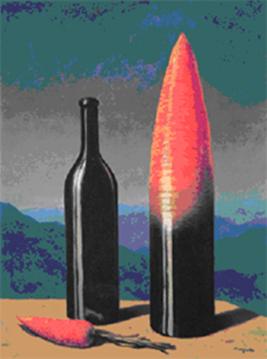
This painting of a wine bottle is by
famous painter Magritte.
Banksy's style has been copied and appropriated and duplicated. Banksy himself is likely to say (tongue in cheek) that you might as well buy "street art" from anyone. Is there that much of a difference between Banksy and not-famous graffiti artists other than name? 

And maybe there just isn't that much difference between a virtuoso on a fancy instrument and the typical busker sawing away. At least not that most people can tell.

But, well, yeah, there is a difference. For one thing, they're not Banksy.

The frame - the "story" around the art object - helps you understand why it is or isn't art. Lots of people have written a lot about this, both simply (Brian Eno) and in much more obtuse fashion. 

A recent study demonstrated people liked wine more if they had been told it was expensive. Exact same idea.

Culture is Framing

Really, everything we think of as "culture" is just a big frame or story around stuff that happened and got made: "This over here is good and noteworthy. This other stuff isn't."

And if you don't believe me, well, a bunch of famous people like Theodore Adorno and Malcom Gladwell and Brian Eno say so, so there!

Saturday, August 20, 2011

Who Uses Your Tools?

Two of the most important records in my life I heard when I was very young. Tomita's "Kosmos" and Jean-Michel Jarre's "Oxygene". They both had extensive lists of the gear used to make the album, which to a young man, seemed mysterious and futuristic.

Tomita's list was huge, and featured things like:
  • AKG BX20E Echo Unit
  • Binson Echorec "2"
  • Roland Space Echo RE-201
  • Eventide Clockworks "Instant Phaser"
  • Eventide Clockworks "Instant Flanger"
  • Eventide Clockworks "Harmonizer"
  • Fender "Dimention IV"
  • Fender Electronic Piano
  • Hohner Clavinet C
  • Mellotron
  • Leslie Speaker Model 147
  • Roland Rhythm Arranger TR66
Jarre's included:
  • ARP 2600
  • Eko Computerhythm
  • Eminent 310
  • EMS AKS
  • EMS VCS3
  • Farfisa Organ
  • Mellotron
  • RMI Harmonic Synthesizer
At the time, these might as well have been spaceship components (hell, Tomita had an actual phaser!) -  incomprehensible and beyond expensive. Over 30 years later, I am familiar enough with gear to know what nearly every single one of the devices on both lists did and sounded like. If I wasn't, the Internet provides endless photos, samples, and emulations.

More importantly, even if I didn't know what exact gear was used, I can now listen to those old records and know how to make those sounds using other gear.

I enjoy learning about the creative process other people use. Studying how others work inspires me to try new methods. I read a lot of blogs and books about how painters paint, musicians write and record, and writers write. I also read a lot about tools.

One of the more commonly-asked questions on these blogs are things like:
"What synths did [artist name] use?"
"Which famous artists used [instrument]?"

People ask these questions to help determine what gear to buy, or if the gear they have is any good.

I think using the exact same tools to make the exact same kind of work is a recipe for uninteresting art - you'll inevitably make bad copies of the things you love.

Using the same paints and brushes as Magritte won't make you a good painter, and it won't make your painting better. Using the same typewriter as William Gibson won't make you a better writer. So why should using the same equipment and sounds as [your favorite band] make you a better musician?

A better approach is to try to emulate feel, vibe, or style with radically different gear. Or if you love the gear, use it to make very different music. The differences are what make it interesting.

There's nothing wrong with copying as a form of study - Arshile Gorky famously copied paintings by his colleagues as part of his art self-education. But when you're ready to express yourself, pay less attention to who else uses your tools and more attention to how you're using your tools!

Tuesday, August 16, 2011

Talent, Art, and Fun 2: History

A tangent to my follow-up to this article about a woman and her relationship with playing guitar and music...and how everyone reacts to her artistry.

A bit of my own personal history, through her words.

I wanted to play guitar ever since I could remember. I did have a sense of how great it might feel to perform and sing, but I had no idea how long, convoluted, and confusing the path could be.

One of my earliest childhood memories is of my father playing the acoustic guitar. I can honestly only recall him doing it this one time. I was around 3 years old. I'm pretty sure he sang "Suzanne" by Leonard Cohen, and "I Think It's Going To Rain Today" by Randy Newman, both of which Judy Collins had covered, and he had some of her records.

I just thought it was awesome.

Other formative childhood experiences were seeing The Monkees on TV at my grandmother's house in Texas as a young child. Discovering these new things called "synthesizers". Finding out that FM radio was broadcasting rock music for free all the time. And then seeing my first music videos.

I started playing instruments in the 4th grade, but that was band/symphony/orchestra. I wanted to play rock music...but how? With whom? There weren't any books that I could find. But one day my parents hooked me up with something called "RockSchool". Books at first, and then a whole TV series on public TV, no less.


On the one hand, they made it look easy. And yet it was still mystifying. It was a start. (In later years, I'd realize the keyboard player they added in season 2 (Alistair) played keyboards on The Chameleons UK's album "Script of the Bridge", a favorite of mine.

But all of this was before the Internet, and finding out all this stuff was next to impossible. Learning how to do it required lots of driving to little Mom and Pop music stores in the middle of nowhere.

None of my friends had any interest in it, and my parents were not musicians. My Dad never played the guitar again after that time when I was very young.

With rock guitar, it helps to be shown a few tricks. 

Chris Haines ("Chaines") taught me to play guitar. He was the main guitar player in my college band, a long-time musical collaborator, and for a while, my best friend. He gave me tablature books. He played me records. He showed me the critical importance of alternating up-down picking ("None of that rake bullshit!"). He taught me the open G minus the third on the "A" string ("Mute that 'A' string with your index finger, because the third sounds like shit!"), and how the metal guys all played the open A with one finger and muted the high "e". I still use those faster, cleaner chord versions today. He showed me bar chords. How to tap. How to play harmonics. Really, everything I needed.

I took some lessons not long after, just to learn the "unified neck" and get some fancier chords under my fingers.

“Your brother is good at music,” the rap went, “while you are good at drawing and and other things.”

My brother is good at music. He's always been good, and it's always been a source of pride and envy for me. He's a much better guitar player than I am. I think he's a better pop songwriter. I'm probably a bit weirder, and tend to finish more projects, though. 

His band had a record deal, made a record in a real studio. Got on a movie soundtrack. If you caught them on the right night in the late 90's, they were the best band in L.A. I still listen to their records, and much to my brother's chagrin, some of his solo work. 

I remember the first time I borrowed Michele Deppler's 4-track recorder to do some early synth noodling. I came home and found my brother had recorded a guitar instrumental called "Ebb Tide". I wish I still had a copy. But I instantly understood he was always going to be "better at this" than I was.

I don't think my parents really understood how important music was to me until I went off to college. My brother went to art school. He was the "creative one", I was the "smart one". My brother is brilliant, in fact. And I believe I've demonstrated some creativity. I think my folks figured I'd "grow out of it". Must have been a bit of a surprise when I took my fancy degree and drove out to L.A. to be a rock star. To their credit, they were supportive as long as I was doing what I wanted.

I also went to school with a bunch of other kids who were ridiculously talented. They inspired me to start my own band and influenced me for many, many years after school ended.

to me rock’n'roll was writing your own songs and playing your own instruments. 

My first real band started writing songs at our first practice. We only learned covers to fill out our set. I still think bands that don't use backing tracks are hands-down "better" than those that do. The funny thing is I spent many years in L.A. playing live with sequencers and drum machines, and nobody thought it was OK. But somewhere around 2000, it became totally acceptable. I played with a few bands in San Francisco that used backing tracks and and nobody batted an eye.

I gave myself permission to ‘suck’. And with permission to suck comes the ability to rock, and to overcome all the fears and insecurities that had been holding me captive.

Once I left L.A., metaphorically and literally, I started a new creative phase. Personally, I feel I've produced consistently stronger work in the last 6 years than in my entire previous creative career.

If there's one thing that has helped, it's been removing any sense of "pressure" or worrying about "hits" or "success". The best work I've done has come from trusting myself, following my own vision, the weirder, the better.

It's good to remind myself of that every now and then. You should trust your artistic vision and intuition. It's what defines your work as yours!

Monday, August 15, 2011

Talent, Art, and Fun 1: Just Play

Since I'm writing a lot about being "gifted" lately, it seems fitting to comment on being "talented", another subject dear to me.

If you have ever made art outside of grade school, or if you've ever contemplating making any kind of art as an adult, you should read this article. It's about a woman and her relationship with playing guitar and music...and how everyone reacts to her artistry and efforts.

The gender issues addressed in the writing have captured most of the attention, but I think that's the least interesting thing about the piece. I was struck by her comments on making art independent of notions of "talent" and why you might choose to do it at all.

I really didn’t understand the nuances of musical practice, advancement and plateaus, muscle training, etc.,

Learning to play an instrument - any instrument - is difficult. Gaining enough facility and comfort with the instrument to play songs harder still. I'm not even talking virtuosity or finding your own voice, just getting to a point where you can play. And unless you are very lucky, you're probably walking this particular road alone, with either modest encouragement ("sounds like real music!") from your friends and family, or something ranging from bemusement ("you're weird", "I thought that was for kids") or even active discouragement ("you're wasting your time", "you suck").

Getting good at music takes a long, long time. Like anything. There are plenty of people who quickly master emulation of their particular idiom (that kid sounds like an old bluesman! that lady sings jazz that sounds like that other lady that sang jazz!), but in some sense it's just a cargo cult. As I've noted before, moving beyond simple imitation or being a pastiche factory takes time, skill, and guts.

There's always going to be people "better" than you at whatever you do. You can either let that deter you and beat you down, or you can let it inspire you and give you some guidance. Most of the time, I've been able to focus on the latter. Sometimes, people are just so damn good I want to give up!

...only some would ultimately be deemed worthy to publicly perform music: those who were ‘musically talented’. And that talent was determined by one’s ability to imitate, precisely, music written by others.

John Philip Sousa called it. Since the invention of the recording machine, the culture of the amateur musician withered and was replaced with "professional executants" and a passive audience.

The re-democratization of production and distribution of music in the late 20th century began to reverse this trend. But it's still more common for people to say "I am not creative" and "I am not good at music".

Being "good" isn't the point. Having fun, or expressing yourself, or working your brain in different ways is the point. (And "good" is one of those ridiculous subjective judgments that falls apart under close examination.).

Recording also changed how musicians worked. Musicians could now study their own performances as well as others, playing and replaying. This led to a certain homogenization of sound in addition to the split between "performer" and "audience".

When you start making music, people will give you "complements" such as "Hey, that sounds like a real song!" What they're really saying is "you almost sound exactly like what I hear. Almost."

This is nothing new - art is culture, and people make their judgments based on what they know best. Presumably that gap between the familiar and you is a bad thing? It's not.

When I listen to the radio, I hear stuff that sounds like music but isn't music. I hear bands that have the superficial characteristics but no depth. The guitars buzz appropriately, the singer's nasal "punk" whine is a perfect distillation of Blink-182's distillation of Green Day's distillation of the Buzzcocks. The songs all go ABABCB and so forth. But there's nothing...exciting about any of it. It's simulated woodgrain veneer on top of particle board. 

This is what happens when your primary criteria for merit is "resemblance to what came before": Stagnation. Let you be you.

I gave myself permission to ‘suck’. And with permission to suck comes the ability to rock, and to overcome all the fears and insecurities that had been holding me captive.

There are plenty of artists who have made "great art" while having either rudimentary skills or only using the very minimum of their substantial skill set.

And having objectively great skills is absolutely no guarantee of making good art. There are countless "guitar noodling" records, plenty of classical musicians who play like robots, and lots of technically competent, even excellent, painters who produce bland work.

Whether you're looking at Abstract Expressionism or listening to punk rock or electronica, the key is the ideas and passion matter more than execution. Execution is important only in that it not substantially detract from the ideas and passion. 

And since much art benefits from limitations, if I have to choose between lack of "talent" and lack of "ideas", here's my "talent". Keep it! You'll always benefit from better technique, however. Never mistake lack of skill for "authenticity". It's just lack of skill!

to me rock’n'roll was writing your own songs and playing your own instruments. 

Write your own songs. Maybe they'll be terrible, maybe they'll be great, but they'll be yours. And that is magic and priceless.

You will be clumsy when you first start your art. Try to think of this less as "I am awful" and more as "I am expressing myself". Do it for yourself!

Sunday, June 12, 2011

Melophonic: Classical/Rock Posters

Melophonic is a site which hosts imaginary rock-style gig posters for classical debuts:

So far there's a lot of the real classics. I am hoping they get to the Futurists' Art of Noise, Stravinsky's Rite of Spring, and Antheil's Ballet Mecanique!

Courtesy of the always interesting MetaFilter.

Saturday, May 21, 2011

Self-improvement and the Culture of Elitism

I found this article thought-provoking. Long, but worth it.
The mark of superior people, in Ortega’s sense, is that they consider themselves inferior to what they may become. Self-improvement, for all that it smacks of the self-help shelf at Barnes and Noble, is also, in this way, the rallying cry of the only kind of elite worth having.
Every day, I try to make myself better than I was the day before. Fretless bass, working out, reading, thinking, being a decent human being.

Doing anything well requires some hard work. Daily practice, usually, and a focus on the process rather than the outcome. Science has shown people don't value things that come easily to them, and that even modest effort increases perceived value.

Yet our society has evolved to venerate those who are simply gifted, rather than those who put in the work. Somewhere in the 80s, the hard work became a short montage set to a pop song.

Malcolm Gladwell's recent book "Outliers" pushes the idea that 10,000 hours of practice are required for expertise in something. That may be simple to understand, but it also underscores that it is not easy. That kind of time investment requires passion and discipline.

If my previous post was about not taking others for granted, perhaps one can see this one as saying "don't take yourself - your core self - for granted, either."

Saturday, April 30, 2011

The Analog vs. Digital Distraction

Many musicians and listeners assume analog recording (tape) and reproduction (vinyl or tape) is better.

They claim it is "warmer", "more accurate", or that digital is inferior because it "slices sound into tiny pieces".

Mostly this is the music fan's version of wishing for the mythical good old days.

Analog is not better. It's worse, or at best, it's different than digital.

Those who actually lived and worked in the analog days, have a less-romanticized, more realistic perspective on this issue.

Analog wasn't that great. It was limited, it was noisy, it distorted, and it was expensive to use and maintain.

Noise sucks. Noise isn't a "sense of reality", as one blogger claimed. Noise is unwanted signal. As for "the ear-pleasing nature of analog distortion":
  • Not all analog distortion is the same
  • Not all analog distortion is"ear-pleasing"
  • You may not want distortion
The "new type of silence" noted above has been available in music since all-digital recording and gating of channels on mixers were available. Certainly from the late 80s, and arguably earlier.

The original poster argued that people are more tolerant of "noise" in music now. I disagree. People used to tolerate a ridiculous amount of surface noise on recordings. They had to, because listening through it was the only way to get to the music underneath. (Though I suspect the poster was referring to what he considers "noisy music", which is basically music with slightly more abrasive timbre)

In the last few decades, recording technology has removed surface noise and improved quality of reproduction. This means artists can now work with noise and more subtle sound treatments and have it heard.

Just as the first recordings favored loud voices and instruments, the newer, quieter, clearer technologies allow for softer voices and using sounds that would have been previously hidden behind tape hiss or vinyl surface noise. In fact, entire electronic pop styles have evolved out of using timbres that sound just like tape hiss or vinyl surface noise!

The relentless march of instrument technology has also put "noise tools" in the hands of composers in ways that allow them to precisely shape and sculpt any sound. The artists working in so-called "noise" genres are still addressing a niche audience, comprised largely of people looking for something different. The people listening to this music have always been more tolerant of non-traditional timbres.

Reasons people think "analog sounds so good":
  • They don't have it. You always want what you don't have. 20 years ago everyone wanted to ditch their 1/2" 8-track Otaris for ADATs and DA-88s, because the 8-track analog machines distorted and were too noisy!
  • People like what's familiar. Most of the "great records" people are familiar with were made on analog gear using old-fashioned methods. Digital recording and instruments allows for a whole different kind of music to be made, and neither the artists nor the listeners have a grip on it yet.
  • Mythology and a grain of truth. Early CDs and digital recordings did sound relatively less awesome when compared to top-quality analog recordings. But in the 21st century, the quality of analog/digital/analog converters is quite high even at low prices. The myth persists, however.
I can't think of an "analog" recording that wouldn't be just as good digital, or vice versa - when the tools are properly used. These days, digital sounds great - if you know what you're doing. Same with analog. You can make "clean" or "dirty" recordings with both technologies.

My issues with analog are that it's very expensive, power-hungry, and challenging to maintain. In other words, it's elitist - and that may explain why it is so popular amongst some musicians.

At least in my case, the problem with my music isn't that it's being recorded (or created) digitally instead of analog. I can best improve my music by improving the quality of what I'm creating, not how I'm creating it.

In the end, people listen to music, not recordings.

Saturday, August 07, 2010

Vonnegut on being an artist

Today's wisdom:
"So many people think that practicing an art is a good way to make a living. Practicing an art, no matter how well or how badly, is a way to make your soul grow...it's not a trade." - Kurt Vonnegut
Starts at about 6:22. Read him, he's great.

Monday, July 26, 2010

This is a little old but worth posting.

In a bit of 20th Century music news, FirstSounds.org has figured out a way to play back some of the world's earliest sound recordings. The folks over at Tonehammer, a purveyor of fine samples, made free reproductions available:
Invented in the 1850s by French inventor Édouard-Léon Scott de Martinville, these "Phonautograms" actually predate Thomas Edisons earliest recordings by nearly two decades.

They were made by projecting sound into a cylindrical horn attached to a stylus, which in transferred the vibration into lines over the surface of soot-blackened rolls of paper. These captures were purely optical.
No device existed which could translate the recorded acoustic information back into sound, until the First Sounds organization acquired the artifacts, with the help of the French Academy of Sciences. They worked with scientists at Lawrence Berkeley National Laboratory and other experts to devise a method of scanning and deciphering the images.
I used some Tonehammer products on my soon-to-be-released "Reflection" album. Good stuff!

Monday, November 16, 2009

John Cage vs. Robert Rauschenberg

John Cage, Merce Cunningham, Robert RauschenbergWonderful music blog Synthtopia asked a great question:
Why do people still hate John Cage?
(when they love Robert Rauschenberg)

I believe the answer lies in cultural differences between the worlds of art and music, and in how popular (i.e. non-university/ivory tower) culture interfaces with and accepts visual art and music.

The primary problem is music fans are like Grampa Simpson - "I don't like change!". The audience for "serious" music has never really moved beyond the 19th century (and that's being charitable!). Classical concert-goers still worship the ancient ones - Bach, Mozart, Beethoven, Wagner, Brahms. Maybe you can get some classical fans to listen to Debussy - but only the "nice" stuff.

All the interesting music akin to the exciting 20th century art movements (expressionism, futurism, collage, dada, abstract expressionism) is "hard to listen to", and it's difficult to convince symphonies, with their high overheads and dwindling audiences, to take a chance...even on something as relatively mild as Stravinsky's Rite of Spring. As a result, people don't get to experience much of Cage's works, and inevitably what gets played by symphonies is what is reinforced as "the best".

Meanwhile nearly everybody else is listening to pop music (and I include here any flavor of electro, house, metal, country, hip-hop, etc.) and few of those listeners are interested in, understand, or appreciate John Cage's innovations. A quick glance at the comments on the Synthtopia article unfortunately confirms this - some the normally well-considered, open-minded folks revert to the stock comments about Cage - "he's a charlatan/my kid could do that", "his ideas are more important than his art", and of course, "it's not real music". Cage would have whole-heartedly supported and endorsed all of the previous statements, by the way.

But these are exactly the same comments leveled at Rauschenberg, Pollock, and other visual artists of the 20th century. Presumably these statements are made by people who think Caspar David Friedrich or Leonardo Da Vinci or whoever painted the crying clown with the flower are the only "real artists".

Art changes as culture changes, because art reflects and is culture. When we shut art down, we're shutting down cultural change, literally living in the past, off of old, received ideas. People hated Beethoven and Wagner at first, too.

Cage's body of work is as diverse and thought-provoking as those of his good friend Marcel Duchamp - and they are the most important artists of the last 100 years (or more).

However, finding good recordings of said Cage works is challenging, because what gets recorded is what will get bought, and people don't like Cage's music. So there's a vicious cycle.

Plus some of Cage's works don't translate well to the recorded environment, either because they're "conceptual" or because they rely on improvisation or chance, meaning that a particular recording of them is completely beside the point.

Finally, visual art has a certain immediacy - you look at something, you get it. And if you don't, you can look away and come back to it later. People's hyperbole to the contrary, it's hard for something you look at but don't like to "hurt your eyes" (bright, flashing lights aside). Music is inherently temporal - you have to sit through it, and in some cases, actually pay attention. That's hard for a lot of people. And in some cases, the sounds are jarring, loud, and inescapable.

We don't have to like every piece of art we experience, but we should at least try to appreciate it and understand why it's important or interesting before we go back to listening to our old favorites. This requires effort on our part. We have to change our culture, our education, and our mindsets and not fear or shirk that effort.

It's a challenge. When I observe the world these days, I see a retreat from empathy, from understanding, and from the effort required to look beyond easy, shallow surfaces. Cage believed music was all around us, everywhere. We just had to go to the trouble to listen to it. How can anyone not appreciate that?

Friday, July 31, 2009

Marcel Duchamp, The Boomtown Rats: The Power of The Original Version, and Thomas Dolby

A recent Metafilter article brought up the subject of Marcel Duchamp's "readymades". The Readymades were everyday objects that Duchamp called art. The two best-known are a bicycle wheel stuck to the top of a stool and, most famously, a urinal signed "R. Mutt".

Some people argue that in fact these were not items off-the-shelf, but pieces specifically created by Duchamp to look like off-the-shelf items.

This coincided with the release of a remastered version of "In The Long Grass", by The Boomtown Rats. Until this event, this was one of the few albums in my vinyl LP collection which was not available on CD (or in any digital form).

I was at the gym, starting my workout as the album came on. I couldn't wait to hear it in nice, clean, crisp sound. I was surprised to find the album order had been changed from my USA release. And even more surprised to find 3 of the album's 10 tracks ("Drag Me Down", "Dave", "Lucky") to be totally different recordings.

There was a moment of wondering if I had fallen into a parallel universe. I wasn't sure what was going on. Maybe I was so used to hearing the degraded vinyl version that the new fidelity was confusing me.

But no, I'm a musician, I have good ears. These were different mixes with different vocals. And I didn't think I liked them!

I got home and asked my friend The Internet, and he told me the truth - these were in fact the original mixes. Bob Geldof and The Boomtown Rats had to do the new mixes and recordings for the US release. And Bob & co. felt the new versions were markedly inferior to the original versions. So for the album, they'd decided to put the originals back on, restore the correct running order, and release the "correct" version of the album.

Well, this really bothered me. I actually had first heard the other, "bad" versions. And I liked them. In fact, I liked them better than the "correct" versions. But I also really liked the album and really liked the band. I could have gone to my grave not hearing the new version of the record and never thought anything was amiss.

I think about Marcel Duchamp.

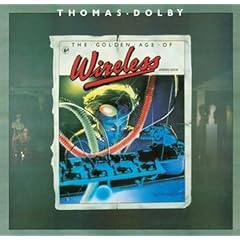
Then, out of the blue, Thomas Dolby reissues a nice, deluxe, definitive version of his debut album, "The Golden Age of Wireless".

I originally owned this album on cassette. I listened to it extensively in the early 80s. At TIP one year, I met a girl who also had a copy. We were listening to hers and the second track ("Radio Silence") came on. Her cassette had a very different version of the song than mine did. Hers had guitars and live drums. Mine was synthesizers and sequencers. Weird.

Over the next few years, I found out that "Wireless" had not only been released in these 2 different versions, with different mixes of "Radio Silence", but had originally been issued without its biggest hit ("She Blinded Me With Science") and its best track ("One Of Our Submarines"), and had included Thomas Dolby's first 2 songs "Leipzig" and "Urges".

On top of that, there were some versions that used the "short" version of "She Blinded Me With Science" and some that used the more famous 12" mix (famous for its stuttering "Sci-i-i-ence" edits, one of the sounds that defined 80s dance music).

There were different versions of the album cover. There may have even been different versions of "Airwaves" - some with the bridge, some without.

Which one of these was the "right" album? The definitive album?

There are other instances of this sort of confusion around the "original" work, whether it is George Lucas "improving" the early Star Wars movies or Star Trek's original series getting "digitally remastered" (i.e. completely re-done) special effects.


Todd Rundgren once said that after he'd heard a mix 3 times it became the final, definitive mix for him. He's concisely describing what I'm getting at here: The first experience one has with a particular work is usually the defining experience. Regardless of what tweaks the artist may insist are needed (or not), the viewer seldom notices the differences - unless the works are put up against each other in a "spot the differences"-type of comparison.

The original experience is the one that contains all the power. Any later modifications cannot substantially affect this original experience. It is said "You only get one chance to make a first impression" - that's especially true in art.

I think this also means there's little value in revisiting previous works with an eye towards "improving" them. While I find it interesting to hear the Boomtown Rats' other takes on their material, it doesn't change my feelings about the album as a whole, or the missing tracks, or the new/replacement tracks. The best thing about the Thomas Dolby remaster isn't the changing of the running order to what is "correct", or the deletion or replacement of "Science", "Submarines", "Leipzig", and "Urges". It's the addition of long-lost singles and b-sides, some of which I've never heard before.

Whether Duchamp created the readymades from scratch or not is irrelevant at this point - everyone experienced the idea of the readymades with the (possibly incorrect) understanding they were common household objects. That idea gave them power, even if it's not true, or wrong, and even if the artist could take it back or change it later.

The initial impact of the idea matters most. Aim carefully. You only get one shot.

Wednesday, July 15, 2009

Creativity and The Gear You Need

Gear. No matter what your work or hobbies are, there's probably gear that goes along with it. Good gear, bad gear, cheap gear, expensive gear, stuff in fashion, stuff out of fashion.

I spend time on sites like MatrixSynth and Vintage Synth Explorer, as well as more focused blogs like Chris Randall's Analog Industries and Stretta, reading about instruments and recording devices.

The merits of particular synthesizers and other music gear are regular topics of conversation. Like any community there are The Topics - the stuff that gets brought up over and over and never resolved, such as "digital versus analog", "plug-ins versus hardware", "what should I buy?" and "which piece of gear is better/best?"

The last topic in particular is one I find somewhat silly. In most cases, the differences between the gear being discussed aren't meaningful in any sense. If reasonable people (or even Internet forum readers) disagree, it cannot be clear-cut, can it?

Even if one could prove an identifiable difference, that's not the same as demonstrating that one particular approach/sound/item is "better" than the other for the purposes of doing something creative.

There are people who will say "oh, well, if you're doing house music, you have to have a 909", as a way of saying a certain piece of gear is standard, if not "required" for a given genre. I think using exactly the same gear that other people in your chosen genre is a good way to sound just like everybody else - and that's a bad thing!

For creative endeavors, my experience and belief is the outcome - the creative work - matters far more than what went into it. For modern recorded music, the end listener really has no idea what created what they're hearing - and most of them don't care what created it, either.

In the case of the "vocal chain" - the microphone, pre-amp, and other gear that gets the voice to the recording media - people will argue or discuss the gear to death. But few people acknowledge the importance of getting a good take from a good vocalist, on a good piece of music. The performer matters more than the gear, always.

In general, I think worrying about the "sound quality" of synths or other gear is a distraction or a way of avoiding deeper issues. Does the gear one uses really make that much of a difference, once it is in a mix, reproduced over varying playback systems?

Let's assume it does for a moment. Do you really want to be making music so dependent on one instrument or timbre? If you do, the choice is clear - you get a Moog or whatever exxxpen$ive gear you need and that's the end of it.

Is the problem with your music really that the "Moog Voyager sounds too clean, and you need a vintage MiniMoog" or that "your synth has DCOs and VCOs are better"? Or that you need a new $2,000 microphone preamp?

Or is the problem with your music about 6 inches in front of the mic or the synth?

I think people focus on gear discussions because it's much less scary than talking about the deficiencies of the most important gear in the chain - you.

It's easy to say "my music is bad because I don't have [insert expensive gear here]". In my case, I know I'm going to get more bang for the buck by improving me. Writing better music, performing it better, making the most of the gear I have.

Pick an instrument you already have and do something with it. Quit worrying about the sounds it doesn't make, the alleged deficiencies, or what it doesn't do. Use the sound it does make - and make something.

I think there's a dearth of writing and discussion about creativity out there - I'm contemplating a project (blog, book, or something) focusing on creativity, process, and outcome rather than gear.

Monday, May 11, 2009

Duke Nukem, Axl Rose, and the Urgency of Art

Duke Nukem Forever is never coming out. 3D Realms, the studio developing the game, closed their doors last week. Their previous title in the series, Duke Nukem 3D, was extremely popular, sold a ton, and helped build today's game industry. It made 3D Realms a ton of money.

What happened to Duke Nukem Forever? They took too long.

3D Realms announced the game back in April of 1997. 12 years. That is a long time to work on any artistic or commercial endeavor in any industry. It's absolutely ridiculous in the PC game space, given how fast hardware and operating systems evolve. To put it in perspective, the OS people were using at that time was Windows 95!

I do not have the inside scoop on what happened with 3D Realms, but I can speculate. I am sure the company was under tremendous pressure to ship another smash hit, and back in the late 90s choice of game engine was a big deal. id Software's Quake engine was one, the Unreal engine was the other. Duke Nukem started development using the Quake engine and switched in 1998 to the Unreal engine.

This is never a good sign in the game world. Another game which also made a similar engine switch was epic failure Daikatana. Changing engines requires a ton of work with no immediate benefits to the product, only potential benefits. It eats time, money, and team energy. It is also indicative of an error in product planning. Any project considering swapping out such a major component needs to consider whether or not it should simply be canceled.

Axl Rose and the rest of Guns N'Roses were some of the biggest rock stars in the world in the early 1990s. Their popular debut album "Appetite For Destruction" gave them wealth and credibility, so much so that the band couldn't figure out what to do next, releasing a fumbling EP, a sloppy double album of mostly older, pre-Appetite songs, and the inevitable covers album. That covers record, "The Spaghetti Incident", came out in 1993. (Parenthetically, I was working at The Record Plant in 1992 while Guns N'Roses were there recording this album).

The band was, again, likely under pressure to deliver a smash follow-up album of original material. They started writing and recording in 1994, but apparently could not make things work. The band effectively broke up in 1996 and was reconstituted as an Axl Rose solo project while retaining the name. In 1998, the then-current line-up began recording.

"Chinese Democracy" was released 10 years later. The band wasn't recording every day for the entire 10 years - indeed, it's hard to know exactly when the tracks were recorded. It is also doubtful that Mr. Rose and the band were hunched over pianos, quill in hand, writing for that entire time.

Band line-up changes are tough to handle, but in "singer-with-a-band"-type situations, there's usually one principal songwriter (or at least editor) anyhow, and in this case, it was Mr. Rose. From what information is available, it is clear he was the principal songwriter for the album's material.

One could also posit that Mr. Rose was being meticulous in his recording, aiming for some sort of sonic perfection, detailing, or "vibe". But I don't believe that is the case either.

For Duke Nukem, some game footage, animations, and renders have leaked out from the ruins of 3D Realms. While there isn't even a game to evaluate, from what I can observe, it was simply a new Duke Nukem game - same characters and enemies from previous games tarted up in the latest high resolution drag. It's a first-person shooter. Even when these titles really push the boundaries (see Half-Life, Thief, Deus Ex), they're still basically the same game. There is little to suggest that Duke Nukem Forever was going to be a revolutionary title worthy of over a decade of development.

You can go listen to "Chinese Democracy" for yourself. It's a competent hard rock album. People complement it by saying "well, it sounds like a Guns N'Roses album, and certainly sounds like it could have come out after 'Appetite For Destruction.'" Except that the band spent 10 years making it...and that's all they have to show for it? (It is also rumored the album cost $13 million dollars to create, making it the most expensive recording project in history).

I believe both of these projects suffered from similar issues. It wasn't simply the pressure of delivering a bigger follow-up to a commercially successful product. I believe it was a loss of urgency.

There is a belief in the commercial art and entertainment businesses that people can create "hits" reliably and repeatably. And while this may appear to be true for some individuals and companies, I believe that success is out of the control of the creators.

It is possible to execute your ideas well and deliver a financially solid product. But one never knows when a work is going to resonate with the public, catch the Zeitgeist, be in the right place at the right time - whatever - and truly blow up.

As a result, you're better off shipping frequently and as fast as possible.

Creativity is a fire. It cannot be kept up raging for a long period of time on the same project. The longer something stews, the less exciting it becomes. Finish the idea as fast as possible and move on. There is no "perfect". There is only "better".

The more you create, the better you get at all aspects of creating including "finishing" in every sense of the word, and releasing/shipping.

Duke Nukem Forever didn't have to switch engines. They could have released the originally-planned game. If it was "fun", it would have sold. If not, the problem was with the original design, not the engine. Some people still play the (now retro) Duke Nukem 3D. It's "fun", even if the engine is primitive.

Even with the engine switch, presumably the studio had a vision and plan for finishing the game. Somewhere in there they lost it, and started freaking out about what to add, change, drop. One must stay focused.

For Guns N'Roses, the picture is less clear. Mr. Rose is famously volatile and demanding. Still, it is hard to hear the album released in 2008 without thinking this album could have been released in 1999.

If I were Mr. Rose, I would have gone to the public and said "I'm never releasing Chinese Democracy, but I have a new album I recorded last week." Make it fast, ship it fast. Especially for popular music, there's really little benefit in working for years. Many hit songs were written in less than an hour.

Things are a little different for "classical" works - some of that can be due to the sheer number of parts, some of it can be due to compositional rigor - but there are also examples of pet projects composers worked on for many, many years (Bartok's "Bluebeard's Castle", for example) which didn't live up to the hype.

Ultimately one needs to remember that with each passing hour, day, and year expectations rise as well, and probably exponentially rather than linearly.

All of the above is why I do the RPM Challenge every year. Perhaps Mr. Rose should give it a try in 2010. As for 3D Realms, I wish them the best of luck.