Thursday, May 21, 2009

Dave Allen likes my Faded Flowers Shriekback Cover

Mr. Dave Allen from Gang of Four and Shriekback has taken a liking to a cover I recorded of Shriekback's sublime "Faded Flowers". You can read what he had to say here.

You can get the track from Alonetone.

I am incredibly flattered. Both Gang of Four and Shriekback were big influences on my musical development.

Dave has been a big advocate of the next music business model and is continuing to promote new stuff over at his Pampelmoose site.

This track was one of the last and best things I recorded at The Hive in L.A. before shutting it down and moving to San Francisco. Ace producer Ken Kessie helped with the mix and the always fantastic Anne Kadrovich contributed backing vocals.

The original track has long been a favorite of mine and is a standout on Shriekback's wonderful "Oil and Gold" album.

Monday, May 11, 2009

Duke Nukem, Axl Rose, and the Urgency of Art

Duke Nukem Forever is never coming out. 3D Realms, the studio developing the game, closed their doors last week. Their previous title in the series, Duke Nukem 3D, was extremely popular, sold a ton, and helped build today's game industry. It made 3D Realms a ton of money.

What happened to Duke Nukem Forever? They took too long.

3D Realms announced the game back in April of 1997. 12 years. That is a long time to work on any artistic or commercial endeavor in any industry. It's absolutely ridiculous in the PC game space, given how fast hardware and operating systems evolve. To put it in perspective, the OS people were using at that time was Windows 95!

I do not have the inside scoop on what happened with 3D Realms, but I can speculate. I am sure the company was under tremendous pressure to ship another smash hit, and back in the late 90s choice of game engine was a big deal. id Software's Quake engine was one, the Unreal engine was the other. Duke Nukem started development using the Quake engine and switched in 1998 to the Unreal engine.

This is never a good sign in the game world. Another game which also made a similar engine switch was epic failure Daikatana. Changing engines requires a ton of work with no immediate benefits to the product, only potential benefits. It eats time, money, and team energy. It is also indicative of an error in product planning. Any project considering swapping out such a major component needs to consider whether or not it should simply be canceled.

Axl Rose and the rest of Guns N'Roses were some of the biggest rock stars in the world in the early 1990s. Their popular debut album "Appetite For Destruction" gave them wealth and credibility, so much so that the band couldn't figure out what to do next, releasing a fumbling EP, a sloppy double album of mostly older, pre-Appetite songs, and the inevitable covers album. That covers record, "The Spaghetti Incident", came out in 1993. (Parenthetically, I was working at The Record Plant in 1992 while Guns N'Roses were there recording this album).

The band was, again, likely under pressure to deliver a smash follow-up album of original material. They started writing and recording in 1994, but apparently could not make things work. The band effectively broke up in 1996 and was reconstituted as an Axl Rose solo project while retaining the name. In 1998, the then-current line-up began recording.

"Chinese Democracy" was released 10 years later. The band wasn't recording every day for the entire 10 years - indeed, it's hard to know exactly when the tracks were recorded. It is also doubtful that Mr. Rose and the band were hunched over pianos, quill in hand, writing for that entire time.

Band line-up changes are tough to handle, but in "singer-with-a-band"-type situations, there's usually one principal songwriter (or at least editor) anyhow, and in this case, it was Mr. Rose. From what information is available, it is clear he was the principal songwriter for the album's material.

One could also posit that Mr. Rose was being meticulous in his recording, aiming for some sort of sonic perfection, detailing, or "vibe". But I don't believe that is the case either.

For Duke Nukem, some game footage, animations, and renders have leaked out from the ruins of 3D Realms. While there isn't even a game to evaluate, from what I can observe, it was simply a new Duke Nukem game - same characters and enemies from previous games tarted up in the latest high resolution drag. It's a first-person shooter. Even when these titles really push the boundaries (see Half-Life, Thief, Deus Ex), they're still basically the same game. There is little to suggest that Duke Nukem Forever was going to be a revolutionary title worthy of over a decade of development.

You can go listen to "Chinese Democracy" for yourself. It's a competent hard rock album. People complement it by saying "well, it sounds like a Guns N'Roses album, and certainly sounds like it could have come out after 'Appetite For Destruction.'" Except that the band spent 10 years making it...and that's all they have to show for it? (It is also rumored the album cost $13 million dollars to create, making it the most expensive recording project in history).

I believe both of these projects suffered from similar issues. It wasn't simply the pressure of delivering a bigger follow-up to a commercially successful product. I believe it was a loss of urgency.

There is a belief in the commercial art and entertainment businesses that people can create "hits" reliably and repeatably. And while this may appear to be true for some individuals and companies, I believe that success is out of the control of the creators.

It is possible to execute your ideas well and deliver a financially solid product. But one never knows when a work is going to resonate with the public, catch the Zeitgeist, be in the right place at the right time - whatever - and truly blow up.

As a result, you're better off shipping frequently and as fast as possible.

Creativity is a fire. It cannot be kept up raging for a long period of time on the same project. The longer something stews, the less exciting it becomes. Finish the idea as fast as possible and move on. There is no "perfect". There is only "better".

The more you create, the better you get at all aspects of creating including "finishing" in every sense of the word, and releasing/shipping.

Duke Nukem Forever didn't have to switch engines. They could have released the originally-planned game. If it was "fun", it would have sold. If not, the problem was with the original design, not the engine. Some people still play the (now retro) Duke Nukem 3D. It's "fun", even if the engine is primitive.

Even with the engine switch, presumably the studio had a vision and plan for finishing the game. Somewhere in there they lost it, and started freaking out about what to add, change, drop. One must stay focused.

For Guns N'Roses, the picture is less clear. Mr. Rose is famously volatile and demanding. Still, it is hard to hear the album released in 2008 without thinking this album could have been released in 1999.

If I were Mr. Rose, I would have gone to the public and said "I'm never releasing Chinese Democracy, but I have a new album I recorded last week." Make it fast, ship it fast. Especially for popular music, there's really little benefit in working for years. Many hit songs were written in less than an hour.

Things are a little different for "classical" works - some of that can be due to the sheer number of parts, some of it can be due to compositional rigor - but there are also examples of pet projects composers worked on for many, many years (Bartok's "Bluebeard's Castle", for example) which didn't live up to the hype.

Ultimately one needs to remember that with each passing hour, day, and year expectations rise as well, and probably exponentially rather than linearly.

All of the above is why I do the RPM Challenge every year. Perhaps Mr. Rose should give it a try in 2010. As for 3D Realms, I wish them the best of luck.

Sunday, March 15, 2009

MP3 Sound Quality Survey

The latest article making the rounds concerns an 8-year study undertaken by Stanford Professor and composer Jonathan Berger.

His study seems to indicate that young people increasingly prefer the sound of music encoded in MP3 format (at 128 kbps) to more accurate reproduction methods, including original CD audio, higher bit rates, and a proprietary wavelet audio compression technology.

There are 2 things to note here:
1. This should not be surprising
2. Who cares?

This should not be surprising. The last 10 years have seen a dramatic rise in the usage of MP3, and I'm sure most of the people in the survey have spent more time listening to MP3s than anything else. The artifacts introduced by the compression are what music sounds like to them.

It's no different from audiophiles who go on and on about how vinyl "sounds better". Vinyl does not sound better. It sounds different. It is a terrible reproduction format, and requires very expensive gear to reproduce at quality (which makes it elitist and bad). Every time you play vinyl records, you degrade them a little, eventually destroying them. Vinyl records warp. They skip and pop. They have lots of surface noise and all kinds of phase problems in the high end. They can't handle much energy in low frequencies, especially when it's not dead center. I could go on.

Tape has problems. Mechanical reproduction (like phonographs) has problems, too. Every generation from the 20th century on has grown up with its own reproduction technology, and they all think their particular technology is the best sounding thing ever, and don't want to give it up for whatever the "crappy" (but actually better) new thing is.

Put another way, old people like black and white movies. Today's digerati fetishize low-resolution 8-bit graphics and the "chiptunes" of early video games. Instruments abandoned for their limitations and quirky sounds are embraced by later generations of musicians for precisely those reasons. People are still going on about how film looks better than video, regardless of resolution.

If most of what you've heard is "sizzly" MP3s, stuff that isn't a sizzly MP3 isn't going to sound right. And it's also worth noting that over the last decade, musicians have started mixing with MP3s in mind.

More importantly...

Who cares? Seriously. For the time being, the record business isn't going to stop releasing music on compact disc. In fact, they'll keep re-mastering the records you already own and selling them to you again (and depending on who you believe and what you listen to, those remasters are way better or way worse). Sales of "audiophile vinyl" are continuing to cook along.

Hell, the music business is still trying to launch higher-definition audio formats. It's too late - new physical formats are never going to go mass-market again. But the golden ears will always be able to spend more money and buy better sounding product (theoretically) to play on their expensive stereos.

So young people like music that literally sounds bad (by objective accuracy standards). I'm not sure how that's any different from young people liking music that sounds bad by subjective artistic or critical standards. Duke Ellington famously said "if it sounds good, it is good". (He didn't actually say that, but that's how it's misquoted). Anyhow, his point was "the only thing that matters is whether you like it". So if people like MP3s, great. They also like light beer, McDonalds, and reality television. I'm not going to hold it against them.

If you want an example of the cynicism and short-sightedness of the music business, look at how they have treated the (allegedly) inferior-sounding digital downloads. They charged the same price. For a low-quality digital file. With no artwork. With DRM.

A few years ago, people were happy to buy 128 kbps Windows Media Audio files for the same price as the full-blown CD. And the industry was happy to take their money. No discount for low sound quality. No free upgrades to higher quality. No premium for higher sound quality.

The industry could have said "yes, sound quality matters, so we're going to sell these low fidelity tracks at a discount, as a teaser or means of price discrimination. You can always buy better quality if you want." That didn't happen.

Instead, the biz sent a message: Sound quality doesn't matter. It's the same message they sent when they sold compact cassettes and 8-tracks. Only recently have they started to also say that it does matter, by offering various more expensive options. Can't have it both ways, guys.

Anyhow, eventually the digital music business will be delivering better-than-CD-quality files - 24-bit 96 kHz WAV files or the equivalent. At that point, we can go back to complaining that no good records have been made since [insert whenever you were a teenager] instead of just saying "kids don't appreciate good sound."

Thursday, March 12, 2009

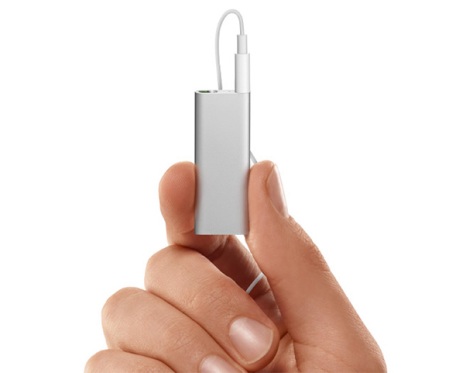
Apple and the New Shuffle: Buttons Cost Extra [Updated]

The new iPod Shuffle is an example of taking ideas too far. Driven by a desire to remove all controls (in particular, buttons) from their products and a business need to churn the product, Apple has produced a bad design that borders on the ridiculous.

There are a number of things wrong with the new Shuffle:
  • Proprietary headphones. Apple has done this in the past and nobody likes it. Aside from Apple's headphones being not that good, use of proprietary headphones adds another failure point. Headphones break all the time. So you're stuck paying Apple more money. Or...
  • Pay for buttons. It's true. Apple has finally figured out a way to make you pay for a button. Not directly, of course. That would be like admitting they're wrong or greedy. Instead, they expect a bunch of accessories manufacturers to fill the void by offering button adaptors so you can use the new Shuffle with your headphones of choice. For those who don't know, Apple collects a fee (and in some cases, a percentage) from these accessory vendors, so Apple is effectively making money selling button adaptors.
  • Speech is tech for tech's sake. I haven't heard the speech synthesis feature yet yet. But I find it difficult to believe it's going to accurately pronounce all the names, titles, genres, and so forth. Speech synthesis in an MP3 player is a clever idea. To my knowledge, nobody's done it yet. I'm sure Apple has patented it and is going to continue to talk about how innovative their tech is. But having the machine tell you what it's about to play is not much more helpful than you just listening to what's playing. I can identify 90% of the music in my giant collection within the first second. It's certainly not going to be any faster than just listening. Speech synthesis is nowhere near as efficient as even a 1-line screen for things like browsing, searching through the content on the device, seeking within a track, and other standard MP3 player functions. Mostly, the speech synthesis lets Apple continue to claim their products are different, new, etc.

The previous iPod Shuffle (the ones with the clip and the buttons on the face) were as close to a perfect minimalist player as one could get. Nice weight. Integrated clip. Well-placed buttons. Small enough to be unobtrusive but large enough to not have to fumble with any of the switches. Look and feel keep it within the iPod family.

Some may take issue with the lack of a screen. I respond that it isn't necessary for the player's intended use case, price, capacity and overall design.

I'm also of the opinion that the original iPod Shuffle (the "stick of gum") was the best of the lot. Yes, it was larger than either of the tiny shuffles that followed. But it wins because it had the USB plug integrated into the body, so no cable was required. All you needed was the player itself.

The new Shuffles (and, unfortunately, the "clip" design) require not just a cable, but a whole custom dock. I believe this is also a commercial decision rather than a straight design or usability one. The size of both new Shuffles would enable a simple mini-USB jack. Apple would rather lock you into their world and platform and require you to carry more stuff around. More to lose, more to break.

Apple doesn't always get it right - the iPod generation with 4 buttons across the top is one example. They backed off of that pretty quickly. Same with the famous "cube" Mac. I suspect the same thing will happen with the new Shuffle. They'll come back to a design with buttons or at least one button or a touch screen or some new gimmick. Presumably You could shrink it down until it's not much bigger than a headphone jack. I just hope they don't build it right into the headphones.

In the meantime, I'm sticking with my Sansa Clip, which I think is even better than the previous iPod Shuffle. Except the Clip looks and feels like a cheap toy, whereas the Shuffle feels like a quality product. That's OK. I'm not looking at it - I'm listening to it. It works with Rhapsody and it sounds great.

Update (03/16/2009): It turns out that older inline iPod/iPhone headphone controls won't work with the new Shuffle. There may be DRM hardware involved as well.

Saturday, March 07, 2009

The Post-RPM blues/New Captain Kirk track

One of the downsides to the RPM Challenge is the post-release letdown. In the days after RPM, I go from elation over completing it to thinking "I should start another album! I'll just keep doing this all year!" to "what am I going to do with myself?" to blackness.

Today I backed up a bunch of projects on my hard drive and went through the sketches and half-finished tracks for my various musical personas. I was surprised to find a few promising ideas and at least one very good track.

I finished up a new Captain Kirk track today - a simple little bass étude. I hope you like it.

I'm hosting it and some of my other pieces at AloneTone, which is an absolutely phenomenal site.

Friday, February 27, 2009

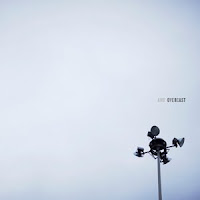
Free MP3 album "Overcast" now available

My new album "Overcast" is finished and available for download. Enjoy.

Liner notes coming soon.

Created for the 2009 RPM Challenge. 8 songs, 35 minutes. Download it (69.1 MB ZIP file).


Video updated with photography credit for James Carrière, who created the amazing images.

Tuesday, February 24, 2009

RPM Challenge: Done and Awesome


A brief update on my RPM Challenge record: I finished the last song last night. Looks like the album is 8 songs, and just under 36 minutes in length. Despite my initial reservations, I'm very proud of this record. If you've liked any of my past music, I expect you will enjoy it quite a bit.

Master photographer James Carrière shot some incredible imagery which Iran is assembling into a book to accompany the record. These photos are so perfect I am quickly running out of appropriately hyperbolic adjectives and will resort to banging rocks together. I am beside myself with excitement about the project.

I'll post updates when everything is all done. I will finish the mastering and CD assembly tonight and the book should be available by Saturday at the latest.

If you're interested in a copy of the CD, e-mail me. I'll have links up for purchasing the book once it's on Blurb with my other books. This year I should also have a full PDF available as well.

You can read all my RPM Challenge blog entries here (including those for 2007 and 2008).

Everything is Amazing and No One is Happy

Much as I like to avoid the SLYT (single-link YouTube) post, this bit by Louis CK from Conan is worth it. In short, we live in an age of wonder and we are unappreciative:


I have to admit I am probably as guilty of this as anyone. I think as technology advances, our expectations rise as well. At this point, so much is possible that we all start to assume that anything is possible, and damn it, it should be fast and free, too.

I will refrain from old fogeying up the joint with a list of "when I was a kid..." comparisons. I will resolve to marvel at the world I live in at least for today, instead of grinding my teeth because my portable supercomputer takes a few minutes to boot up and load 5 office programs simultaneously.

Thursday, February 19, 2009

Sound Synthesis Methods

Paper Synth by Dan McPharlinA few weeks back, Chip Collection wrote a little post asking if all forms of sound synthesis had been invented.

The answer is "of course not" - there will always be more methods of generating sound discovered and implemented, at least by researchers if not musicians.

But the real question to ask is "Does it even matter?"

The art or practice of subtractive synthesis (what a Moog, Prophet-5, Oberheim, and all the other non-DX-7 classic synths use) has been refined and matured to a point where its techniques are robust and powerful. One cannot make "any" sound with it, but the range of sounds a talented programmer using a decently flexibile instrument can create is staggering.

Subtractive synthesis starts with an oscillator generating a simple waveform (triangle, sawtooth, or pulse) with rich harmonics. A filter (usually low pass) is applied to subtract some of the harmonics of the base waveform, thus changing its timbre (and giving the synthesis method its name). Add some envelopes to control volume and the filter over time, and some other modulation and you're done.

When one adds custom waveforms to the usual triangle-sawtooth-pulse combinations, it gets more interesting - other waveforms provide different harmonics to manipulate with the filter and thus produce different timbres. Synthesizers like the Korg Wavestation used this technique. Factor in wavetables (a sequence of waveforms) or samples (very long custom waveforms) combined with subtractive techniques and the possibilities multiply.

Frequency modulation (FM - what DX-7s use) is also extremely powerful, but far more complex to master. Then there's granular synthesis (limited use in instruments today) and additive synthesis.

There are already entire universes of sound that musicians won't explore. Most players use the presets in their synthesizers with little modification. Programming synthesizers becomes more difficult as the instrument gets more powerful. Learning to or wanting to create new sounds is a different thing than learning to or wanting to compose or perform. Many people end up specializing in one or another. After all, how many composers build instruments?

With today's mature synthesis methods, the ability to combine those methods (either in a single instrument or by layering instruments), and the incredible array of effects available, it is easily possible to transform any arbitrary sound into almost any other arbitrary sound using simple tools on a cheap PC. The field is far from played out.

Given that it is usually frustration, dissatisfaction, or boredom with the status quo that drives inventors or artists to look for something new, it's not difficult to see why there's less going on here. When one factors in the business reality that most customers don't want more complex instruments to program and can barely wrap their heads around the existing decades-old technologies, it becomes less likely that we'll see commercial development of new synthesis methods. However, new user interfaces for synthesis that either reduce complexity or try to work in more intuitive or inventive ways are highly likely.

One wonders what Karlheinz Stockhausen could have done had he been interested in using all of today's modern technology and developing new methods of synthesis.

Tuesday, February 17, 2009

Mah RPM Blog, Let Me Show You It (now with working link)

Some people were asking about more RPM blog entries. They're all here - I've only been sporadically copying them over so as not to crowd out the other writing I'm doing.

And of course, to encourage people to get the book once the record is done...

Update: Link should work now.

Monday, February 16, 2009

Musical Instruments - Virtually No Future

I have a Fender Rhodes Mark 1 88-key electric piano. No lid, no pedal, no legs (I keep it on 2 Ikea stools). In decent condition otherwise. But it plays great and sounds great. It weighs a lot and it takes up plenty of space. I almost left it in L.A.

I have a Fender Mustang bass from the 60s. My Rhodes is likely from the 70s. I can get either fixed to "like new" condition for a few hundred dollars and fully restored for not much more than that.

I used to have an Akai S1000 sampler. When I needed to replace the display (a critical part with a built-in lifetime), it took months and hundreds of dollars. Now you can't even get parts for it, so what was several thousand dollars new becomes not merely obsolete, but useless.

Many synthesizers out there use custom integrated circuits. Once the production runs for those custom ICs are finished, there just aren't anymore made. Doing another production run later is prohibitively expensive, assuming you can even get access to the schematics or dies (and you can't).

So when/if your favorite synth blows one of these chips, you need to find another chip from another synth of the same ilk to replace it. Assuming such a thing is possible and you're able to find someone to do the work for you. For many old synths with leaky or dying caps and surface-mounted stuff, forget it. It's dead. The sounds are gone forever. You move on to the latest digital whatever it is that doesn't sound the same or work the same.

Entropy is continually whittling away at the number of available "old" electronic hardware instruments. For some, it's not the insides, but the membrane keypads used as cost-cutting measures as a user interface.

And then there's the coming disaster of software synths. At some point, the latest computer operating system will not support your favorite old un-updated vintage softsynth.

I look forward to the ouroboros - Eventually Native Instruments (or their equivalent) will be offering a virtual virtual synth - "Remember the sound of the DiscoDSP Discovery? Check out 'Recovery', which brings it back to life!" - promising to emulate (in software) the software you used to use (which may itself have been an emulation of an actual synth).

In the meantime, don't get too attached to those synth sounds you love. They probably won't be around in 10 years. Almost certainly not in 20.

Friday, February 13, 2009

The Hope Image, Copyright, L.H.O.O.Q., and the Creation of Value

As many sources recently reported, the Associated Press is going to sue Shepard Fairey for his now-iconic "Hope" poster. The AP claims the poster is a copyright violation since it is derivative of a photograph taken by Manny Garcia and licensed to the AP.

Mr. Fairey admits he used the photograph as a "visual reference". The Hope poster has gone on to sell hundreds of thousands of copies. Mr. Fairey says he put most of the money he made from the posters into making more of the posters.

Whatever you may think, copyright law arguments are supposed to ignore whether the alleged violation "makes money" or not and focus on several other tests. It's not more or less of a violation if you make or don't make money from it.

There are several legal "tests" used to determine whether or not there's a violation:
  • Is the alleged violation "transformative" in nature? This test asks whether or not the new work "transforms" the old work significantly. The new work cannot be a mere replication of the original. It has to "add new meaning". There's a clear, solid argument that it is transformative. This is the essence of what artists like Mr. Fairey do. This is obviously a manipulation of the original image to create a new mood, perspective, and, frankly, image. Mr. Fairey took a portait that I find rather unflattering and was able to recast it as something entirely different. And he did it by changing the original.
  • Is it for the purposes of parody or criticism? I think Mr. Fairey could make some sort of argument here, but if so, it's a rather weak or oblique criticism or parody. This argument will be undermined by the poster's use and endorsement by the Obama campaign.
  • How much of the original is contained in the new work? It would be one thing if Mr. Fairey had literally taken the original photo and slapped "HOPE" across the bottom. That would mean the derivative work contained 100% of the original (and thus the "essence" of the original, which is another goofy test that I don't think remotely applies here). But Fairey's image is several steps removed from the original. It's not clear to me if he scanned, traced, or free-hand drew/painted his version, but the obvious changes (color palette, detail) and subtle changes decrease the amount of the original contained in the new work. If this test passes, it would mean that many others who have taken similar portraits of Obama could also theoretically file claims.
  • What is the financial impact of the new work on the old? This, for me is where it gets interesting.
AP is a company that licenses or buys lots of content from people. They dump the images in a database and don't count on making much from them in the aggregate. Every once in a while they luck into an iconic image and can make a little more.

In this case, AP is arguing something like this:
  • Mr. Fairey's work is a copyright violation
  • Mr. Fairey's work is hurting AP financially
  • AP should be entitled to damages and potentially some or all of the revenue from the violation
But if Mr. Fairey hadn't made the poster, nobody would care about another photo of Barack Obama. Mr. Fairey created new, substantial value for the photo by his creation of the new work and by his promotion and distribution of it.

Unless Mr. Fairey admits otherwise, AP will have a hard time proving that their photo was the only "visual reference" Mr. Fairey used. They may have a hard time proving that he "copied" it by tracing or computer scanning (I don't know how Mr. Fairey works and I haven't seen any overlay comparisons).

Put another way, the poster is, to the average viewer, not a direct re-use of the original AP image. End of story.

AP will also have a hard time proving that he couldn't have created the poster without using their photo. The smart thing for Mr. Fairey to do (and what I suspect his attorneys will ask him to do in the future) would have been to say "I used many different images of Mr. Obama as part of my artistic process, but ultimately the work came from me and my impressions of Mr. Obama."

This article from SFGate notes that some people are saying "well, why didn't he just get a license from AP?" Without knowing the specifics of their licensing process, I'd start by saying "he shouldn't have to, because he's not duplicating or copying their image!"

Imposing a licensing option like this means AP effectively gets control over what Mr. Fairey or you or I or anyone else can do with these images. They can charge too much money. They can require ugly logos pasted everywhere. They can say "no".

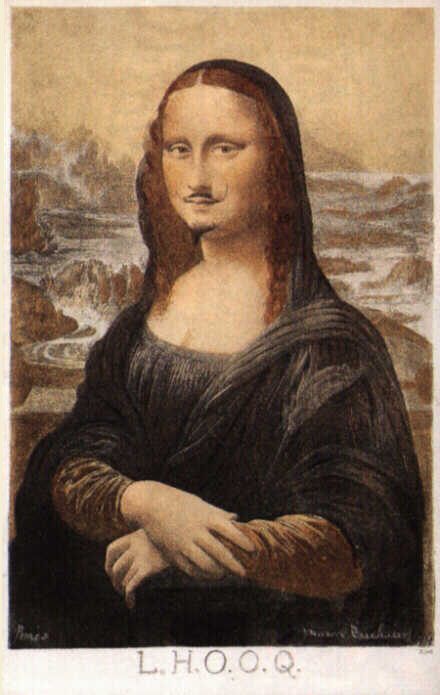
Think about Marcel Duchamp's "L.H.O.O.Q.", one of the best 20th century works. Duchamp created this work by taking a cheap postcard representing the Mona Lisa (so there's already a layer of abstraction) and then adding a moustache , Van Dyke, and the caption "L.H.O.O.Q." (if you say those letters in French, it sounds a lot like French slang for "she has a hot ass").

This piece was scandalous and controversial, as all of Duchamp's best work is. I think it also raises some great questions. Of course, it's knocking the old art world (which venerates the Mona Lisa). Beyond that, it's asking things like "how little does an artist have to do to create something new?"

L.H.O.O.Q. gets much of its effect from the viewer's familiarity with the Mona Lisa image. It's even more powerful if the viewer is someone with a deeper understanding of art history and the art world. But remember, this is built on a cheap postcard knock-off of the Mona Lisa, not the actual painting. Does that make it better or worse?

To me, it makes it even better, because it's starting from a debased and slightly off take on the Mona Lisa. Starting with a postcard also minimizes the "you're just copying" argument, because everybody is copying the Mona Lisa - it's not some lofty thing anymore, it's a poor copy on postcards, coffee mugs, t-shirts and so on.

The graffiti touches are clearly iconoclastic and, to me, hilarious. Much like the Groucho nose-and-glasses, I always find this sort of thing funny. Especially when doodled on Leonardo's masterpiece. Duchamp could have simply added the caption to a straight reproduction of the Mona Lisa. That would have been provocative. But it's the total combination that "works".

I think L.H.O.O.Q. would pass enough of the copyright tests. It's transformative, for sure - it's surprising to me how little he had to do to fundamentally change it (but that's the genius of Duchamp). It also does not hurt sales of Mona Lisa images. If nothing else, Duchamp could hide behind the "criticism/parody" test and get a pass. But today he'd find himself sued by the owners of the rights to the image of the Mona Lisa (yes, there are such fiends) as well as the owners of the rights to the image of the knock-off postcard. And those two groups would likely be facing each other in court as well.

I think AP is going to lose the case, and I think AP should lose the case. Their arguments are weak, their motives disappointing (greed, nothing more, nothing less), and their desire to make culture richer is clearly low.

If, perchance, AP does win, will we ever see another Shepard Fairey or Marcel Duchamp or Andy Warhol or Robert Rauschenberg or Pablo Picasso or any other artists who, forget about collage, just look at pictures before they create? Or even actual things in real life?