Monday, February 14, 2011

RPM 2011: Week 2

Continuing updates on my progress with my RPM 2011 album "The Ghost Town":

Day 7- 3 songs, 12 minutes
More tweaks to "What The Wire Said". Lots of writing and thinking. A bit of experimentation around a new track with a kind of old English melody. Sounds a bit too cheesy right now, but I have a verse and a chorus. We'll see how that goes.

Day 8 - 3 songs, 12 minutes
I played some of the tracks in progress for James (the amazing photographer) and Iran. Feedback was generally good. Surprisingly strong responses to "What The Wire Said", which I was not expecting. And rather muted or tepid reactions to "The Empty Sky", which I think is rather good. I think "Sky" needs mix tightening and some palette changes. The melody and underlying structure are good. Just needs refurbishing.

Still, that bit of feedback sort of knocked me off my game a bit. I had hoped to balance the moodier, slower tracks with some more upbeat stuff. Will anyone want to listen to 35 minutes of slow(cow)poke music? Will I want to make it? Will it be interesting?

Hard to tell.

Day 9 - 3 songs, 19 minutes
Today I extended "What The Wire Said". It's a bit too long now but the general shape is there. I added acoustic guitar in some nice ways and a tiny bit of JX-3P (gotta use that gear!). At 11 minutes(!) this might be the longest track I've recorded. I think it's sounding pretty good.

With the 3 songs I have so far, this feels like about 15 or so minutes, which is really great progress for such a short time.

Day 10 - 3 songs, 19 minutes
Listened to the tracks some more, but aside from some notes scribbling and a brief bit of morning picking, the rest of the day was burned with work-related activities.

Day 11 - 3 songs, 19 minutes
Had to go in to work early today for meetings and had to go to a friend's birthday. Aside from some listening, no work on RPM today.

Day 12 - 3 songs, 19 minutes
Frustration and false starts. Being Saturday, I had hoped to get a whole track done and work out. I started on one track, but realized it was far too derivative of Wall of Voodoo. As in: it sounded exactly like Wall of Voodoo. There's a fine line between homage, influence, and derivative rip-off. I was on the wrong side of that line, but it took a long time to figure that out.

I started on another track, but it felt very stiff and I couldn't get it to feel right. I pushed through sheer force of effort, but I kind of hate it.

By the end of the day, my back was hurting and I was frustrated. I can't remember so many total wipe-outs on tracks in past RPM years, but maybe I'm just selectively remembering. Went to the gym and hoped for a better day tomorrow.

Day 13 - 4 songs, 23 minutes
Got off to a typically slow Sunday start today, but I was determined to finish a track. I went downstairs to the studio and started picking on the guitar. I rather quickly came up with a nice guitar pattern for a verse and chorus.

I sketched out some words and a melody. I tried to focus on the emerging themes and vibe of the record and decided this needed to be the title track. This also forced me to lock in a title: "The Ghost Town".

I struggled to lay down the acoustic guitar - I really am a poor acoustic player. Thank god for digital editing. I think it has a nice, loose vibe, though. I spent the next few hours building up the track, adding in some low synth rumble, melodica, fake lap steel, shaker and vocals.

Lots of time spent experimenting with different acoustic samples and background ambiences.

Finished the track shortly after dinner. I think it's a good one.

Sunday, February 06, 2011

RPM 2011: Week 1


I will be posting some short notes each week about my work on RPM 2011...

Day 1
Fought with Cubase. Couldn't get the metronome working in Cubase 5.52. Still got a skeleton track down. Many pages of notes about what to make this year.
Also realized I didn't have the 1.0.2 version of ValhallaShimmer - important because 1.0.1 didn't support presets!

Beginning track is the first idea that came into my head, currently just a verse/chorus outline.

Day 2
Cubase 6 arrives. Installed. Normally I would never upgrade software in the middle of a critical project, but these can be run side-by-side. Fortunately so far it is way better than 5.52.

More guitars. Song stretched from initial ABCD structure to a more fleshed out IABCD_ABCDDDD type-thing. Started on lyrics.

Feeling extremely tired again, so this is about as much as I can accomplish, other than working on some notes in the notebook.

Day 3
Lyrics for first song finished. Not much done today other than sharpening melodies on the commute - I have to be at work extra early (8 am) and will be staying extra late (leaving after 8 pm). TIRED.

Day 4
Vocals put down in early morning before going off to work.

Can't do much else because of work and tickets to see The Church play 3 classic albums at a nice small venue. TIRED.

On the motorcycle ride over to the show, I start singing some parts for other songs. Hope I remember them.

First song is probably going to be around 4:30. Not a bad start.

Day 5
Pushed a bit further on track 1 (working title: "The Empty Sky"). Burned most of the day having a nice visit with a friend (plus two hours of driving and errands).

After dinner I started a new track ("What The Wire Said"). I am intending for this to be a long epic, but I only have time and patience to sketch it out.

Day 6
Today after a typical late Sunday morning, I expanded on last night's track, building it up to about 5 minutes. I have a long punch list for both tracks so far, and need to keep making progress overall.

Went out for a run and thought about another song. Wrote some words and a melody in my head. Got back and picked out some nice chords on guitar.

Wednesday, February 02, 2011

TIME names MOG App in 50 Best of 2011

The MOG app I designed and manage was recently chosen by TIME magazine as one of the "50 Best Apps of 2011". This puts my work on the same list as Brian Eno's!

Coincidentally, MOG just released a very nice update to the App which went live on Monday.

The TIME magazine citation joins the Billboard "Best Streaming App" award MOG won in 2010. It is quite satisfying to be recognized (albeit abstractly), especially considering some of my history in the business.

Credit is due to the fantastic developers, visual designers, and quality assurance people at MOG. As one of my friends said, I have the easy part: the "dreaming-up" job. They're the ones who actually make it all happen.

MOG has many more great things to add, and some exciting plans for the rest of the year. If you like music, it's worth checking out. Available for iPhone and Android.

Monday, January 31, 2011

A Brief History of the Music Business: Video Talk

A talk I gave at Loyola University on the history of the music business is now available online here.


It's about an hour long and is a distillation of a number of things I've talked about over the last few years.

(Note that I am incorrectly identified as the "co-founder of Rhapsody Music". While I was the product manager and wrote the initial business plan, I was neither a founder of TuneTo.com (where the product and technology were born) nor a founder of Listen.com (which launched Rhapsody 1.0).)

UPDATED: The last, important thing? "WEAR YOUR EARPLUGS." (And disabled the auto-start...sorry about that!)

Saturday, January 01, 2011

Best Reissues of 2010

2010 continued the record industry's trend of jamming out reissues, remasters, and deluxe editions. Selling updated versions of existing products is a marketing trick nearly as old as commerce itself. Clearly, it is working for the music business.

Cynicism aside, many of the first CD releases sounded terrible for a variety of reasons. In some cases, the wrong master tapes were used or the best master tapes couldn't be found. In other cases, the tape-to-digital transfers suffered from the (relatively) poor quality of the early analog-to-digital converters.

Most of the top-shelf musical canon has already been reissued multiple times. So now the industry can turn its attention to albums more off the beaten path. Fewer sales but more devoted fans with high willingness to buy.

The good news is that in many cases, the people working on the reissues do a fantastic job, unearthing rare or lost tracks, cleaning up audio, and producing nice packaging. The bad news is these reissues are often harmed by cut-rate packaging, sloppy audio remastering, a surfeit of tracks, and too-high price tags.

Without further ado, here are the awards...

Best Bonus Tracks:
Duran Duran "Duran Duran"
Duran Duran were one of the first bands that made me hunt and search for tracks and inspired the largely lost art of locating the obscure.

Duran Duran released all kinds of remixes, singles, and 12" maxis which were only available as imports. Their first album even swapped out one of the original tracks ("To The Shore") for a hot single ("Is There Something I Should Know?") when it was widely released in the USA.

And many of those early tracks were great stuff - as good or better than what was on the record.

This year, Duran Duran continued rolling out their reissues. The best was their first album. Sonically, it's not a substantial improvement. Some argue that it sounds worse than the original release.

Of course, it includes all of the b-sides from the singles and 12" maxis, and the "Night Versions". This is less of a revelation since the previously-released "Singles" boxes put them all out there several years ago.

What it does include, however, are some demo versions that are really interesting. The demos are simultaneously both more "rock" and more "disco" than the album versions. The early version of "Girls On Film" has an awkward cadence which would be dropped for the final release version. Mostly they sound like what they are - a live band composed largely of enthusiastic young men.

Artwork and photography is pretty and comes in a nice box. Band loses huge points for not including lyrics, however, which they did even on the previous cheap-o standard release.

Ultimately, this reissue serves to validate the quality of the band's early work and the freshness of their sound, without wearing out its welcome.


Too Much of a Good Thing:
Arcadia "So Red The Rose"
Propaganda "A Secret Wish"

Sometimes, reissues rekindle your love for an old favorite. And sometimes it's like having dinner with your ex-wife: too much, and you remember why you stopped listening in the first place.

The reissue of Arcadia's "So Red The Rose" is fantastic. Seriously. It sounds great. It includes rare videos and specials. A whole second disc of bonus tracks including a whole single I'd never even heard before.

The artwork is mostly an improvement, though the credits contain some typos and fail to reproduce the full artwork the way the initial CD release did.

I also like this record a lot - in some ways, it's the best "Duran Duran" album made, even though technically it's not Duran Duran.

But 2 CDs filled to the rim is a bit much. There are a number of remixes of the same tracks (single versions!) which aren't tremendously different from the album mixes - this is the sort of stuff that makes collectors happy, but makes most listeners reach for the "skip" button.

Propaganda's "A Secret Wish" is also a study in obsession.

Originally released in 1985, "A Secret Wish" was the first album by a new band signed to Trevor Horn's legendary Zang Tuum Tumb label (whose name, like his band "The Art of Noise", comes straight out of the Italian Futurist movement).

The album is a masterpiece of orchestral synth pop. The new (at the time) Waldorf PPG synthesizer is mixed with sampled strings and the unusual voices of the singers to produce something dark, Teutonic, and Expressionistic. Their hand is tipped with "Dr. Mabuse", which also features a sly homage to musique concrete at the beginning. David Sylvian played guitar on the record, even.

The band fell apart after this record, losing one of their female singers and most of their momentum. Their much-anticipated second album (featuring Derek Forbes, Simple Minds' amazing bass player) was not very good. And then they basically broke up.

In 1985, I remember looking at the CD version, which I could not afford, and marveling at the technical information presented on the back, including the producer indicating which songs had digital clicks and "overs". Then I realized the mix durations were different from the vinyl album I had...were they different mixes?

I never was able to find out. The CD version I bought many years later sounded just like the vinyl.

This year, Propaganda's masterpiece received the Deluxe treatment. Turns out the producer did a separate set of CD mixes after the "analog" mixes were done and sent off to the duplicator. These CD mixes are considered the definitive versions, and the original "analog" mixes are relegated to the end of disc 1.

The CD mixes are surprising in a few details. They're not necessarily "better", per se, but they show how nuts the producer was going, clearly obsessed with the project and adding breakdowns, build-ups, crazy string sections, and so forth. The songs stretch out, taking their time through their intros. One is over 11 minutes long.

I suppose it's fitting that music that has been so obsessed over by creators and fans deserves this kind of treatment. You get the definitive album - all 9 tracks, now with great sound. It's all anyone could ask for. But then there are the six analog mixes right after. Didn't I just hear this?

And then there's also disc 2, which features all sorts of odds and ends, including "rare cassette-only promotional mixes". 11 tracks, which are nearly all remixes of the same 9 songs you just spent an hour with.

Too much! Back on the shelf for now!

Way Too Much of a Good Thing:
David Bowie "Station To Station [Super Deluxe Edition]"

Start by noting the original album "Station To Station" consists of 6 songs. It barely hits its 38-minute running time due to the long introduction on the title track.

It is a classic of the rock canon and one of Bowie's better and more listenable records.

The reissue costs more than $100.

It consists of 5 discs: the original album, the 1985 remaster, 2 live CDs, and a disc of singles mixes. To clarify, you get the original mastering (too murky!) and a new master from the original tape (too tinny!), a live concert spread across 2 discs, and a disc with slightly different mixes designed for radio.

They throw in vinyl versions of the original album and live set.

There's also a DVD with more than one set of high resolution and 5.1 mixes of the same 6 songs.

Because that's not enough, they throw in a bunch of other junk, too: liner notes with "never before seen photos", a poster, replicas of backstage passes, concert tickets, fan club folders, membership cards, bio sheet, and some buttons.

It's a great record, essential listening. But the rest of it is the definition of overkill.


Most Welcome Sonic Improvement:
The Cure "Disintegration"

When this record came out, I listened to the vinyl and thought it sounded murky. It had the tired rock disclaimer "this music was meant to be played loud", which meant the band had mixed it too loud and due to the Fletcher-Munson curve, it was going to sound weird unless you actually played it back loud as well.

"Disintegration" is a really good record. It took me a while to realize this when it first came out, but seeing the band at Great Woods sealed the deal for me. If you only listen to one record by the Cure (as many recommend), this should be it.

The remaster largely fixes the murky sound of the original at the expense of adding a bit more unneeded compression (an unfortunate trend in nearly all of these reissues, which I suspect will allow the labels to release "full dynamic range" versions in another 5 or 10 years!)

The "Deluxe Edition" throws in 2 more discs. One is the set of demos for the entire record. Like most Cure demos, these are relatively boring: they're rough versions of the album songs, sometimes instrumental, generally nearly identical to the final versions except not as nicely recorded. No real revelations here, nor anything even die-hard fans will revist.

The other disc is a reissue of "Entreat" (called "Entreat Plus"), a live concert where the band performs the entirety of "Disintegration". The Cure are a great live band, and their live recordings tend to be quite solid. "Entreat Plus" doesn't disappoint, but like many of the reissues this year, by the time you've finished this disc you've heard the songs on the album 3 times. That's a bit much for anyone, and while The Cure play well, they do play the songs just like the album, so again, not much discovery here.

The better sound makes it worth the price of admission, but try to track down the single-disc remaster!


Biggest Surprise:
Nine Inch Nails "Pretty Hate Machine"

It's not fashionable to like Nine Inch Nails anymore, and if you do, it's not fashionable to like this record. The remaster, however, is rather exciting.

It sounds great - arguably the biggest sonic improvement and best overall sounding record of the bunch. I couldn't find a playback system that didn't make this sound amazing.

It's also become an interesting historical document. Some of the tracks on the album have not aged well, but the good stuff ("Head Like A Hole", "Terrible Lie") still sounds ahead of its time.

The record sounds unusually drenched in reverb by today's standards. Otherwise its bracing digital textures sound even fresher today than they did back when it was released 20 years ago. It's easy to hear why this record was so influential for so many aspiring musicians. It's also very easy to hear Trent Reznor's influences - "Down In It" is clearly derivative of Skinny Puppy's "Dig It" (which Reznor freely admits), and much of the rest of the album pulls from various flavors of the near-industrial music of its time.

Friday, December 31, 2010

2010's Greatest Hits

My 12 Greatest Hits of 2010:
  1. January: Started a new full-time job at MOG. As the year progressed, my good fortune was reinforced. Unemployment is high and expected to remain so for a few more years; I am still surprised at how much I'm enjoying my new job. I have great colleagues.
  2. February: Despite a massive computer failure and near-loss of valuable data, I managed to complete my RPM record "Reflection", and people like it! Full release coming soon...
  3. March: Showed surprisingly complete demos of both MOG apps at SXSW to the press, got good reviews
  4. April: Wrote a new song for pop-punk band Victim Nation
  5. May: Attended the wedding of my good friends Rich and Humu; traveled back east to see my cousin Claire get married and see other friends and relatives.
  6. June: Played guitar with The Disciples of Vice.
  7. July: Launched both the MOG iPhone and Android apps!
  8. August: Got fitted for custom shoes and boots.
  9. September: The new and improved Sid Luscious and The Pants debuted at the Portola Festival. Had a nice getaway at a resort.
  10. October: The MOG app I built won Billboard's "Best Streaming App of 2010", beating the Rhapsody app (which I also built!) and the Thumbplay app.
  11. November: Spent a nice Thanksgiving with relatives in Napa and met my brother's fiancee. Congratulations to them both!
  12. December: Celebrated 10 years as a couple with my wonderful wife. And my friend Sid Luscious played a show at the Great American Music Hall.
I didn't write as much as I would have liked, a combination of things like lots of work, Fallout: New Vegas, and various other distractions. I hope to rectify that and my other flaws in 2011!

Happy New Year!

Monday, December 27, 2010

Favorite New Music for 2010 [updated]

I listened to a lot of music in 2010, including most of the albums on most critics' lists. Some were pretty good. Most were terrible. I won't pretend that my selections here are comprehensive or definitive, but I enjoyed all of these records quite a bit.

Album of the Year: Gil Scott-Heron - "I'm New Here"
This record embodies many artistic virtues. It's heartfelt, honest, modern, and brief. Rather than hiring The Roots and recreating the sound of a classic 70s album, producer Richard Russell keeps it contemporary. Like Gil Scott-Heron himself, the album sits somewhere between rap, hip-hop, jazz, and blues.

There are only a few actual songs on the album, but like the chocolate chips in a cookie, this makes them even more special. The rest is spoken word or mood pieces. It's barely a half-hour long. But I love it, and everyone I played it for loved it as well.

Listen to I'm New Here.

Silver Medal: Neil Young - "Le Noise"
Neil Young is 65 years old, and not in the best of health. He could certainly be forgiven for either retiring or putting out a nice, quiet, lazy record.

This year he delivered "Le Noise", an album that felt like the work of a (forgive the pun) young musician. And I mean that in the best way possible. "Le Noise" delivers the kind of concept and production that typically only new musicians go for.

The album is just Neil Young and guitar. But it's mostly electric guitar. So rather than old folky/fogey strumming, Neil Young (and producer Daniel Lanois, for whom the album is punningly named) unleash billowing clouds and roaring oceans of guitar noise, feedback, and looping delays. Only a young musician would have the bravery and excitement about the sound and material to say "you know what, it doesn't need drums or bass or anything. Release it like that." (though I'm awaiting the inevitable "remixes" where people drop drums and bass on top).

But he isn't some tyro - he's a veteran songwriter, singer, and performer, and that means the album also has a sure hand, excellent performances, and solid songs.

Replace Neil Young's name and voice with anyone's, and this record would have likely topped many critics' lists. And again, he keeps it brief - about 35 minutes start to stop, which makes it easy to digest as a whole listening experience.

Listen to Le Noise.


Pop Category: Robyn - "Body Talk, Part 1"
As a songwriter and as someone who "follows the music industry", I listen to a lot of popular music in different genres. Today's modern pop music is really dumb. Willfully stupid. Awful.

This sort of idiocy is embodied by Kesha. Everything about Kesha - production, image, and overall vibe - is crass, cynical, depressing pandering to the lowest common denominator.

So if you want to dance and you want something that sounds good on the radio and you need a blonde pop tart to present it, what do you do?

Robyn is your answer. Produced in the same Swedish gene labs as Abba and other pop superstars, Robyn released 3 EPs and an album this year, all called "Body Talk".

It's great Top 40 radio dance pop, full of synthesizers, drum machines, and bright, harmonized vocals. No Auto-Tune singing robots.

What sets Robyn apart from everyone else? Songwriting and emotion. Robyn writes wonderful melodies (and unlike Kesha, she writes her own material). She sings with emotion and a big, solid voice. And her lyrics aren't half bad, especially when compared to the scribbling that most other pro songwriting teams hand in.

"Body Talk, Part 1" is a great example of pop music circa 2010. Solid songs, and again, brief. I think it's a better listening experience all the way through than Part 2, 3, or the full album. However, make sure you also check out "Indestructible", which is a really strong song missing from "Part 1".

Listen to Body Talk, Part 1.


Instrumental Ambient: Robin Guthrie - "Carousel"
Robin Guthrie played guitar in Cocteau Twins, and his solo records sound like Cocteau Twins albums minus the keening vocals. I find this to be a great improvement.

Shimmering chorused clean electric guitars twinkle like snowflakes or city lights. There's the occasional synthesizer or electric piano. On some tracks drums splash and crash in the distance. The tempos are slow and dreamy.

It's surf music in space, or at the bottom of the sea.

Yes, it can be a little same-y at times, but it's pretty. I found myself playing this at work a lot and probably listened to this more than any two of the other albums on this list combined. Some of it is quite beautiful, and a few of the pieces are evocative and emotional. Another short record, too!

Listen to Carousel.

Hip-Hop: The Roots - "How I Got Over"
Everyone is gushing over the new Kanye West album. I can only assume that Kanye's hype and obnoxious public persona are what they're really paying attention to.

There's no other reason for the public to continue to ignore or underrate The Roots. Real musicians playing real instruments, writing their own hooks rather than sampling others. They can rap. They have lots of friends. But they don't jump up on stage in front of people and say outrageous things.

They made what may be their best overall album this year. While it doesn't really have a track as immediately arresting as "Get Busy", nothing else out there really sounds like this. It's a rare hip-hop record filled with the joy of making music rather than the joy of posturing. 

Like many of my favorite albums, this really grew on me over time this year.

Listen to How I Got Over.


Late To The Party: Iggy Pop - "Preliminaires"
This record came out in mid-2009, but I didn't really listen to it until this year. It's a "fake jazz" album, according to Iggy. It's also a sort of sci-fi concept album, brief, and in some ways similar to the Gil Scott-Heron album.

Iggy's voice sounds wonderfully rich, deep, and weathered. He's got a synthy cover of "Insensatez", a New Orleans-ey stomper ("King of The Dogs"), and a tip of the hat to some of his old stuff ("Party Time").

But my favorites are the slower, darker numbers like "I Want To Go To The Beach" and "It's Nice To Be Dead".

Many people will dismiss this album because they only want to see Iggy smearing peanut butter on his lithe frame and yowling about TV Eyes and his Lust For Life. But Iggy is 63 - nearly the same age as Neil Young - and this is a much more age-appropriate record (for Pop and for me!) without being embarrassing! It's the kind of album that reminds you for all of his stage antics, Iggy Pop is an artist.

Listen to Preliminaires.

[UPDATE] Other Notable Albums:
  • LCD Soundsystem "This Is Happening" is a more consistent album than "Sound of Silver", but because it sounds almost exactly like the last record, it's less transcendant. Still very good, though
  • Bryan Ferry "Olympia". I really wanted to like this record more. I dug the remixes of "You Can Dance" more than the album version, though. Still pretty nice.
  • Underworld's "Barking" started off pretty strong but failed to keep up all the way through. It's also very much "more of the same" from them, which is both very good and very bad at this point. I really liked the first 3 tracks.
  • Devo's "Something For Everybody" was a great album the first few times I listened to it. Then, like bubblegum, the flavor wore off. The brickwalled mastering hurt my ears. The record runs at least 4 songs too long (brevity is the key in 2010, guys!), and Devo undermines their own breathtaking cynicism with some open-hearted ballading. I can't tell if they're joking or not, and that's a bad thing. Still, when you first hear the robot disco grooves of songs like "What We Do", it's hard not to start doing bad new wave dancing.
  • The new Kanye West album had a couple of good tracks on it, but these were offset by the relentless hype as well as a few tracks that were so amazingly, jaw-droppingly bad I could not get all the way through them.
  • I really wanted to like the Big Boi album. I thought it was boring. 
  • Most of the 3rd Harold Budd & Clive Wright collaboration album "Little Windows" was good, but I have a hard time recommending it to anyone who doesn't think Harold Budd is a genius. And many of Clive Wright's tracks should be half as long and lighter on the vibrato.
    There's a lack of "first albums by bands" on this list in 2010, which is personally disappointing for me. I want to like new music by new bands. I just didn't hear any that made an impact this year.

    10 years after the "digital revolution" little has changed.  The iron grip radio and MTV held over taste-making, the public ear, and stardom has been replaced by Pitchfork and other blogs and various internet sites and memes. Look at most of the lists people cite and you'll see a tremendous amount of similarity. This is more due to the effectiveness of PR machinery than a true consensus on how "great" some of this music is.

    Still, plenty of good stuff came out this year.

    Up next: 2010's bumper crop of reissues!

      Thursday, December 23, 2010

      WikiLeaks Thoughts

      I have mixed feelings about WikiLeaks' recent release of classified information. (Bruce Sterling wrote about it rather well, it's worth checking out.)

      However, I have even more mixed feelings about the response to WikiLeaks. Much like terrorism, I think our reactions to the events are both more telling and potentially more destructive than the events themselves.

      Here are a few things to consider:

      US security for this kind of material is clearly terrible.

      WikiLeaks is a relatively small, powerless, and benign organization. If they were able to acquire this kind of material with relative ease, what can a large, powerful, and malevolent organization achieve? What have they already achieved?

      If all this material was so sensitive, why wasn't it better protected? Individual messages weren't encrypted. It was all easy enough for one person to access without setting off any alarms, and literally walk out the door with it. Again, this person (Manning) wasn't someone with spectacularly high-level security clearances.

      There have been many discussions lately about potential collateral damage:
        • The WikiLeaks release may put diplomats and other agents of the USA in harm's way
        • I have heard pundits say the "revenge" DDOS attacks aimed at PayPal, MasterCard, and Visa may hurt "the poor" (who "depend on credit cards during this holiday season") and "craftspeople" (who rely on the big financial companies to process gift transactions)
        ...and yet there has been very little discussion of the people who have already been actually harmed by actions taken which WikiLeaks and others have uncovered.

        I'm referring to the tens of thousands of Iraqis and Afghanis killed, maimed, and injured; of the people rendered by the USA to other countries for torture and interrogation; of the US soldiers killed in 2 wars, with many injuries and deaths propagandized or covered up.

        This is not to say these wars are good or bad - that's a topic for another post - but the US media continues to ignore the deaths.

        Is it reasonable to attempt to control the WikiLeaks information now that it is available on the Internet? Like any MP3 or movie, the WikiLeaks data is widely available to the general public and will be forever.

        People who work for the government or even may want to work for the government are being discouraged or forbidden from reading the (now publicly available and widespread) material, as if it will taint or corrupt them somehow.

        The admonition seems ridiculous, and the implied threat (if we can prove you read this stuff, you may be in trouble) seems like something from the Soviet Union's darkest days.
        • Clearly legitimate news sites like the New York Times are being threatened for covering the material
        • Companies which provide any services potentially related to this material are being threatened (and are rapidly caving under pressure)
        • These companies are also acting in disconcerting ways - see Bank of America's refusal to process donations to WikiLeaks. Should your bank be allowed to dictate what you can and can't do with your money?
          If all that can happen before any trial or charges, what does it mean for freedom of the press, freedom of speech, and due process? These hammers aren't being dropped selectively, they're being applied broadly and quickly with little diligence.

          The criminal charges against Julian Assange for sexual misconduct or rape, while serious, are a sideshow meant to distract everyone from the serious security breach and the even more serious information contained in the cables; and from the corporate and government reaction to same.

          Whether he is guilty or not is not relevant or germane to a discussion of the content of the cables; and it's not relevant to a discussion of whether having this information out there is a good or bad thing.

          And note that while mud is being slung loudly at Assange, very little is being said about Bradley Manning, who is being held in SuperMax-style solitary confinement. This is considered incredibly harsh treatment, bordering on torture. The U.N. is investigating his conditions. Manning hasn't been convicted of anything, he hasn't had a trial. He's not particularly dangerous. The government is willing to "detain" him in solitary for 23 hours a day. What will they do to you when you protest?

          Finally, I would note WikiLeaks and other related groups are being labeled things like "anti-establishment" and "anarchists".

          The whiff of 50s-era Red Scare-ism aside, last time I checked, "anarchists" were people who "seek to overturn government, with no purpose of establishing any other system of order in the place of that destroyed."

          That sounds a lot like the current USA Republican party and/or Tea Party (same thing), who want to "shut [the US] government down". They've threatened and implied violence if they don't get their way. They haven't come back with any plans. 


          Troubling times.

          Tuesday, December 21, 2010

          The Shape of The Universe, 15 years ago

          About 15 years ago I released an ambient/electronic album called "The Shape of The Universe". Despite being both all instrumental and using some electro-acoustic compositional techniques, this album is one of the more popular things I've done.

          It spent nearly 6 months on top of the MP3.com experimental charts and sold enough to convince me there was a future for independent musicians willing to work hard.

          I created this record during a one-month stint while I was unemployed. My "job" was working at my rehearsal studio in L.A.

          Having broken up my band after several years of trying to write "hits", playing guitar, singing, and trying to please other people, I decided to make some music just for me, without regard for what others might think.

          I can still remember working on this project and playing some rough mixes for my musician friends. I was surprised at how well-received it was, and that early feedback from people like Justina Klimkevich, John Kaizen, and my brother convinced me to finish.


          You can download the whole thing, or just listen here:


          The equipment I had at the time was laughably small and limited compared to what I enjoy today. The entire gear list for this recording project is as follows:
          • Roland Jupiter-6 synthesizer (thanks, Chris Fudurich!)
          • Casio CZ-101 synthesizer
          • Akai S1000 sampler (with 8 MB of memory)
          • Yamaha SPX-90 digital effects unit
          • Roland GP-8 effects unit
          • Tascam 488 Portastudio (8 track cassette machine)
          ...and that's it. Well, I played a china cymbal on one track. And recorded the clothes dryer.

          This album was released on cassette. My brother designed an intriguing cover. And we decided to include a random selection of 3 of 24 "trading cards" as well. This was the beginning of my interest in alternative packaging for music.

          After all this time, I'm thinking that I should probably do another Captain Kirk album. I'm also contemplating a book that will reproduce the trading cards.

          Friday, December 17, 2010

          Who's Wrecking Your Product?

          It really does only take one person to wreck a product.

          Sometimes they wreck it before it's even started. Sometimes they wreck it while it's being made. Sometimes they wreck it after it's done.

          Creating a product requires many things:
          • Clear vision - this includes what need it should address, why it's being built, for whom, and what the timeline should be. 
          • Realistic goals - this includes the budget and resourcing as well as the expected feature set and benefits to the company bottom line
          • Carefully balanced trade-offs between all of the competing elements
          • Discipline 
          Ultimately, the product manager is responsible for all of the above. But in many companies, product managers lack the authority to enforce those items. In others, the key decisions are either made or overridden by senior management.
            Steve Jobs Wrecked Your Product
            "Boom! I just wrecked your product!"
            Why blame The Steve? He's legendarily, heavily, deeply involved in nearly all aspects of product creation for Apple. Mr. Jobs really does make many, many decisions. And he's frequently, annoyingly "right", in the sense that Apple's products have sold extremely well since his return from exile.

            Many books have been written about Steve Jobs and Apple, dissecting them both and seeking the reason for their success. I think in both cases it comes down to one thing: discipline.

            Apple seems to realize the value of restraint. Less is more, especially in software. They initially launch with a sometimes laughably small number of features...but they all work, and work well. They slowly add high-quality features over time. This approach is very similar to the "kaizen" process that Toyota uses. Developing with discipline beats rushing out a feature-complete-but-buggy 1.0 and then trying to patch it.

            Steve Jobs is very good at helping decide what to leave out. He understands that good products are narratives (like, say, Pixar films). They have a central theme which must be supported and reinforced.

            Steve Jobs has caused 2 major problems for everyone else, though. And both are the result of being blinded by surface and style rather than focusing on deeper critical thinking.

            Steve Jobs Wrecked Your Boss
            Nearly every high-level executive I can think of secretly (or not-so-secretly) wants to be Steve Jobs. They admire his panache, life story, fashion sense, reputation, and of course, massive success.

            Unfortunately for many, one of their takeaways from Steve Jobs is "I need to micromanage my product team". They insist on arbitrary product reviews with no clear next steps. They make changes without a strategic or tactical understanding, of the project goals. They don't stay informed about the product constantly, and rather like the Eye of Sauron, swing in to focus on it erratically and painfully.

            They change the central theme of the product. They move goalposts. They revoke previous decisions.

            Steve Jobs sets clear goals at the outset: Who's the ultimate decision maker? (he is, and he stays involved) What's the theme of the product? What are the resources? And so on.

            If your supervisors emulate the wrong aspects of Steve Jobs, you may be wrecked before you even start. Getting around bad management is a challenge for the best product managers. Sometimes it is clear that bad management will wreck your product. It's almost always better to ship even a flawed product than to bail out, however.

            So, misunderstanding leadership lessons from Steve Jobs. What else? How about misunderstanding design!

            The Cargo Cult of Steve (or, Your Company is Not Apple)
            I have a kitchen timer that looks like an original iPod. Because it was designed and made when iPods were popular. It is a terrible, terrible product. And it is obvious the company that made it wanted it to look like an iPod to cash in.

            While it is superficially similar to an iPod, in practice, it is the antithesis of what made the iPod popular. It takes a relatively simple product (a countdown timer) and turns it into something incredibly annoying and difficult to use.

            Reasons why it's terrible? Off the top of my head:
            • Button layout arbitrary and inappropriate for purpose
            • Buttons are too stiff
            • Inscrutable UI
            • Lack of attention to detail
            It feels awful to use.

            I don't know the folks who created this thing, but I can imagine the meetings where they decided (or perhaps the boss demanded) to adopt the visual language of the iPod without understanding the product thinking that led to that visual language. It is cargo cult thinking.

            Products get wrecked when companies decide to emulate other products' surface appearance without understanding the thinking that created that appearance in the first place.

            This is different from following "industry standards", "best practices", or even "trends". Those all have their place when they are conscious decisions made with intent.

            Copying Apple is a conscious decision, and the intent is clear - emulate success. But Apple's success (and design) come about because the company makes conscious decisions with intent.

            Another frequently cited example is the use of 3D buttons and glossy effects. Apple doesn't make buttons glossy and 3D just because they "look cool". They do it to make the buttons stand out clearly from the rest of the flat, matte interface. Many other OS widgets (Android, Windows 7 for example) use glossy and 3D effects in a gratuitous fashion, and frequently the shiny highlight makes text less legible.

            Design elements should never be gratuitous. If you're doing something for no other reason than "it looks cool", reconsider. That said, "looking cool" can add value provided you're not interfering with the rest of your product functionality.

            Your boss might misunderstand Steve Jobs. Don't allow yourself or your team to misunderstand Apple and design in general. Make conscious decisions with intent. Think about what you are trying to accomplish and what would work best.

            Let form follow function. Or at least make sure the form is informed by function, or you know what your trade-offs are. Innovative and exciting designs frequently spring from re-focusing on what the customer is actually trying to do, rather than merely sprucing up existing design conventions.

            Don't let Steve Jobs wreck your product! Be disciplined. Make your own choices with intent.

            Up next: Your Team!

            Tuesday, December 07, 2010

            SuperWaitress Remix for The Folk Opera by Annie Bacon

            The talented Annie Bacon (late of Sweet Crude Bill and the Lighthouse Nautical Society) recently released her epic project "The Folk Opera". As part of this, she asked me to do a remix of the song"Superwaitress".

            It's now available. Go check it out!

            Thursday, December 02, 2010

            Why Products Really Suck, Part 1

            Image from: http://bit.ly/dM9CtS
            I recently read this rather glib and uninformative article about "Why Products Suck". It got me thinking. I've made and shipped a number of products. Some won awards. Some were terrible.

            I've definitely learned a few things, and I can definitely provide more insight than the above-mentioned article's key points, which were:
            1. It only takes one person to make your product suck.
            2. Nobody ever got fired for sucking.
            3. It’s easier to suck more than suck less.
            4. There are more ways to suck than to not suck.
            5. Customers demand sucky products.
            So I'll be doing a series of articles on making good products. First, let's look at what's wrong with this article.


            First point. The author claims "It only takes one person to make your product suck." There are a number of interesting and correct directions he could take this statement. But his actual point is that you need consensus among your "team" that your primary goal should be "not sucking".

            It is true that it only takes one person to wreck a product. There's a New Yorker cartoon I used to have taped to my wall that showed a guy at a desk writing on something his subordinate handed him, saying "I just need to make one change that will ruin all the work you've done."

            Frequently, that person is not who you expect them to be, and they will be the subject of a future article.

            I will also discuss the pros and cons of team consensus.

            Second point. "Nobody ever got fired for sucking". This is sadly true, however the point as presented in the article is rather weak. The author is basically saying "you should fire bad people" without clarifying the differences between:
            • appropriate and inappropriate risk
            • initiative and running wild
            • genuine accidents/mistakes and negligence
            Good teams and good managers not only get enough rope, they sometimes get tangled up in it. Not every risk pays out, and some risks lose big. That's why they're risky. Start-ups take bigger risks than established companies, and new products take bigger risks than established ones. They have to in order to survive.

            I'll discuss risk and failure as well.

            Third point. "It's easier to suck more than suck less". His somewhat dippy phrasing covers the best point he makes in the article: Serve the right customer. Don't be so desperate for customers you build features that aren't core. You'll attract the wrong customers and then be beholden to them with even greater costs for getting back on track.

            There will be a nice long article about discipline in product design.

            Fourth point. "There are more ways to suck than not to suck." His point here is "you need to be careful with your choices and define your product clearly before you start development". This is true, but many of the examples he cites are not relevant to that point at all. There are tactical mistakes one can make. Choosing the wrong user interface widget isn't one. Good UI designers don't really have choices with too many questions if the product is well defined - in those cases, the best (or at least better) tactical choices are fairly obvious.

            Strategic choices are much more difficult and much more important, and frequently glossed over in both theory and practice. I firmly believe that making great products is not particularly difficult if the environment is good and the team is competent. I'll cover that as well.

            Fifth point. "Customers demand sucky products." This is a rather provocative statement, given the "customer is always right" attitude that dominates. The author's main point is , but he follows it up with a poor, or at least insufficiently specific suggestion:
            Trust your instincts and the tiny set of users who use you, and resist advice from the billions of people who don’t.
            Good product designers do have instincts, but those instincts are informed by experience, best practices, and lots of research.

            Your current users are frequently the last people you want to be talking to about how to evolve your product. In the early stages of a product, your users are likely to be unrepresentative of the larger user demographic, unavailable in sufficient numbers to float your whole business model on, and highly demanding.

            For more mature products, your users are again likely to be unrepresentative of the next tranche of users you hope to attract, and will be used to how your product works. They are likely to demand minor iterations or evolutions of features.

            The short answer is "talk to people who are like the users you want to have", and the long answer will be coming in a new post soon.

            Up Next: Who's wrecking your product? (Answer: Steve Jobs. Seriously).

            Tuesday, September 14, 2010

            Apple Shuffles On

            As predicted, Apple has abandoned their button-free iPod Shuffle design for a return to the "ring button" layout of the very popular clip-style iPod Shuffle. It's a much better design.
            The "new" iPod Shuffle, now in many colors. (image courtesy of Apple)

            Overall, it's still expensive and feature-poor compared to the Sansa Clip, which offers more memory, an FM tuner, and a screen, but it is a much nicer-feeling product. The Sansa Clip still feels like a toy, as do most non-Apple MP3 players.

            Ultimately, the new iPod Shuffle is a mature, solid product and in many ways, a perfect design.

            The new Nano is a bit more baffling. I suspect it's just marking time and covering a price point for Apple, as they can't yet get iPod Touches down to a cheap enough price point, can't charge more for the Shuffle, and are unwilling to leave a gap in their iPod price line for a competitor to fill.

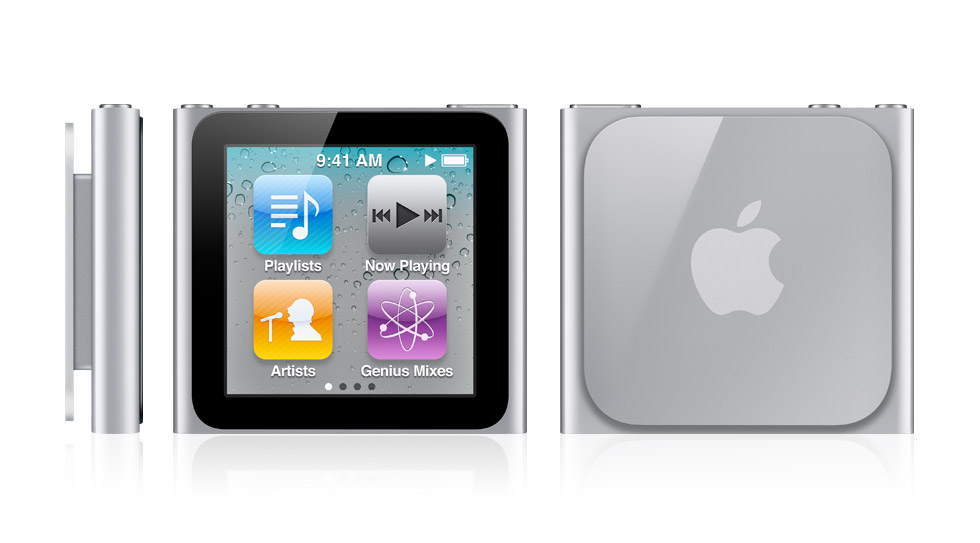
            The current iteration of the iPod Nano (image courtesy of Apple)
            As a technological achievement I suppose the new Nano is rather nice, but as a product, it's sorta goofy.

            I did somewhat anticipate their grafting a touchscreen onto such a tiny form factor, but after the addition of the camera to the Nano in the previous round of revisions, I expected it to be the Shuffle that got it, rather than the Nano.

            That would have allowed Apple to claim they were still moving forward on the Shuffle design rather than "retreating" to a previous one, and would have left the door open for more advancements in Nano land (the lack of a camera on the new one is arguably a big step backwards).

            In its current design, the Nano is intended to be clipped onto one's clothing, like the Shuffle. But in practice, this means both the display and the controls for the unit are facing out and away from the user, so the user has to look down at their clothes and/or pull the Nano towards themselves to see and manipulate it. Because the screen is the control surface, and because it is so tiny, it is very difficult to hold the Nano while controlling it, and while you are pushing its surface, much of the screen is obscured.

            Contrast that with the "candy bar" Nano design. Its hardware controls and orientation allowed for "blind" operation - you could skip tracks or pause in your pocket, without looking at the screen. Because it was "candy bar" style and size, it afforded gripping in the hand while looking at the screen, without obstructing the screen.

            The new Nanos also don't allow users to install or run apps (and I'm glad about that, because otherwise there would be yet another Apple mobile configuration to design for), but their visual interface design picks up many of the cues of Apple's higher-end products, including fancy animations, a pivoting display, "multi-touch", and more. Much of this is simply gratuitous, but goes a long way to justifying the pricing in consumer's minds.

            I find the much-vaunted "multi-touch" control silly and inferior to the simple elegance of the click wheel for something like the Nano. The Nano itself is hard to pin down - it's too fancy and fiddly for the gym, the Shuffle being far superior for that.

            Eventually, I expect Apple to merge these two products - their design framing suggests they're headed this way. Again, I suspect it's a matter of covering price points while they wait for component and design costs to come down, for all aspects of the product line. When they do, I hope they manage to keep more of the ring button design and less of the touchscreen, but past behavior sadly indicates otherwise.

            In the meantime, Apple manages to monetize its quirky design choices and its decisions to emphasize the "feel" of products as much as their actual features.

            Most people, even hardcore audiophiles, are better off using a smartphone or iPod Touch-type device as a music player. If you need a portable for the gym, I'd still recommend the Sansa Clip over the Shuffle unless you're an all-Mac person. The Sansa Clip may feel like a toy, but that minimizes the pain you feel when you drop it or lose it.